
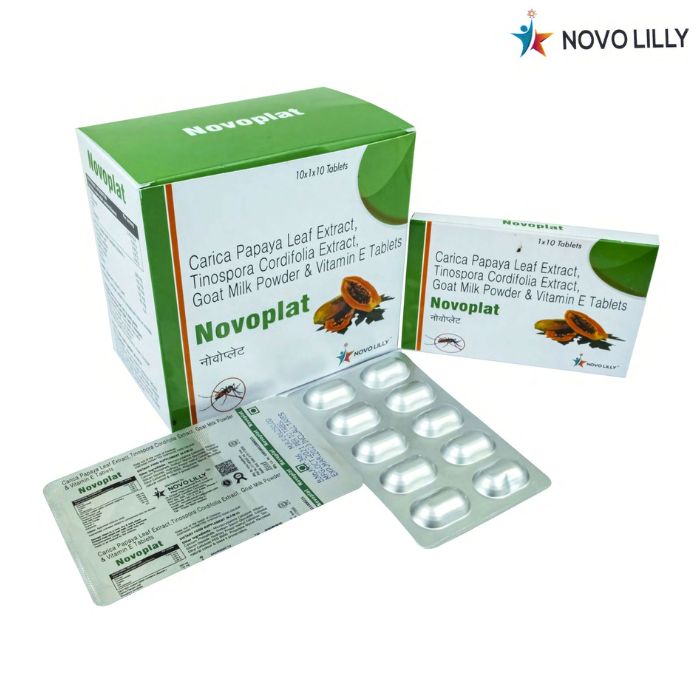
Carica Papaya Leaf 1100mg, Goat Milk Powder 100mg, Tinospora 150mg, Wheat Germ Oil 40mg, and Swertia Chireta 125mg Tablet is a multi-ingredient botanical and nutritional solid dosage formulation containing several plant-derived and nutritional components in different quantities. The high proportion of Carica papaya leaf material alongside lower-quantity botanical and nutritional ingredients makes raw-material standardization, powder flow, blend uniformity, moisture control, and compression important areas of formulation development. For companies building a diversified PCD Pharma Franchise portfolio, this type of herbal tablet can be developed with controlled sourcing, standardized specifications, analytical testing, and appropriate packaging.
The first stage of developing this formulation is the qualification of its botanical and nutritional raw materials. Carica papaya leaf, Tinospora, Swertia chireta, wheat germ oil, and goat milk powder can have different physical and chemical characteristics depending on their source and processing method.
For botanical ingredients, specifications may include identity, purity, moisture, foreign matter, microbial quality, and applicable marker or extract parameters. The exact specification depends on whether the material is supplied as a powder, extract, or another standardized form.
Goat milk powder requires separate consideration because its moisture, particle size, flow characteristics, and microbial quality can influence the finished blend. Wheat germ oil also requires suitable handling and protection from environmental exposure.
Establishing consistent raw-material specifications is therefore an important foundation for achieving reproducible finished-product quality.
Carica papaya leaf is present at 1100mg, while other components are present in substantially smaller quantities. This difference creates a significant blending challenge because low-quantity ingredients such as wheat germ oil at 40mg and other botanical components must be distributed uniformly through a much larger powder mass.
A staged premixing strategy may be used during formulation development to improve distribution of the lower-quantity components. Geometric dilution or another validated blending approach can be considered according to the physical properties of the raw materials.
Particle size, bulk density, flow characteristics, and moisture content are evaluated before final blending. These parameters help identify potential segregation risks.
Representative sampling from different locations within the blender can be used to assess blend uniformity. Controlled transfer from the blending equipment to the compression stage further helps preserve the uniformity achieved during processing.
The presence of goat milk powder and wheat germ oil introduces additional considerations for moisture and powder-processing behavior. The formulation should be handled under environmental conditions appropriate to the stability requirements of the individual ingredients.
Wheat germ oil may require a suitable carrier or adsorption system if the finalized tablet formulation does not permit direct incorporation of the liquid ingredient. The selected approach should provide uniform distribution without negatively affecting powder flow or tablet compression.
The final blend is evaluated for flow, bulk density, compressibility, and moisture. These characteristics influence die filling and tablet-weight consistency.
Compression parameters are optimized to produce tablets with suitable hardness, thickness, friability, and mechanical integrity. Excessive compression may affect disintegration characteristics, while insufficient compression can lead to fragile tablets.
In-process monitoring of tablet weight, appearance, hardness, and other applicable parameters supports consistent manufacturing.
Quality control for this multi-ingredient tablet requires a combination of physical, chemical, and microbiological testing. The exact analytical program depends on the specifications established for each raw material and the finished formulation.
Botanical ingredients may be evaluated through identity testing and, where applicable, marker-compound or extract-specific testing. Goat milk powder can be assessed according to its relevant nutritional and microbiological specifications.
Finished-product evaluation may include appearance, average weight, weight variation, hardness, friability, moisture, disintegration, and applicable assay or marker testing.
Microbiological quality is particularly important for formulations containing multiple botanical and nutritional raw materials. Appropriate raw-material qualification, environmental controls, equipment sanitation, and finished-product testing help maintain the required quality standards.
Analytical procedures should be appropriately qualified or validated for their intended purpose.
Stability studies help establish how the tablet maintains its physical, chemical, and microbiological characteristics throughout the proposed shelf life. Monitoring may include appearance, moisture, hardness, friability, disintegration, relevant marker compounds, and other applicable quality attributes.
Moisture protection can be important because several botanical powders and milk-derived ingredients may be affected by environmental humidity. Wheat germ oil can also require consideration of oxidation during storage.
Packaging is therefore selected according to the formulation's stability profile. Blister packs, strips, bottles, or other suitable systems may be evaluated for protection against moisture, oxygen, light, and physical damage.
Container-closure performance and packaging compatibility should be assessed during development. Product labeling should accurately communicate the complete composition, batch details, manufacturing information, expiry, storage conditions, and other applicable regulatory particulars.
Carica Papaya Leaf 1100mg, Goat Milk Powder 100mg, Tinospora 150mg, Wheat Germ Oil 40mg, and Swertia Chireta 125mg Tablet is a formulation with a complex raw-material profile and significant differences in ingredient quantities. Its development therefore depends on botanical standardization, controlled premixing, blend uniformity, moisture management, oil incorporation, compression control, analytical evaluation, and stability testing.
For pharmaceutical companies expanding their PCD Pharma Franchise portfolio, this formulation can be developed as part of a specialized herbal and nutritional tablet range supported by defined raw-material specifications and documented manufacturing procedures.
From botanical-material qualification and staged blending to compression, finished-product testing, stability monitoring, and protective packaging, each stage contributes to consistent product quality. A systematic formulation approach helps maintain the specified composition and physical characteristics of the tablets across different manufacturing batches.
Carica Papaya Leaf, Goat Milk Powder, Tinospora, Wheat Germ Oil and Swertia Chireta Tablets with formulation and quality details.