
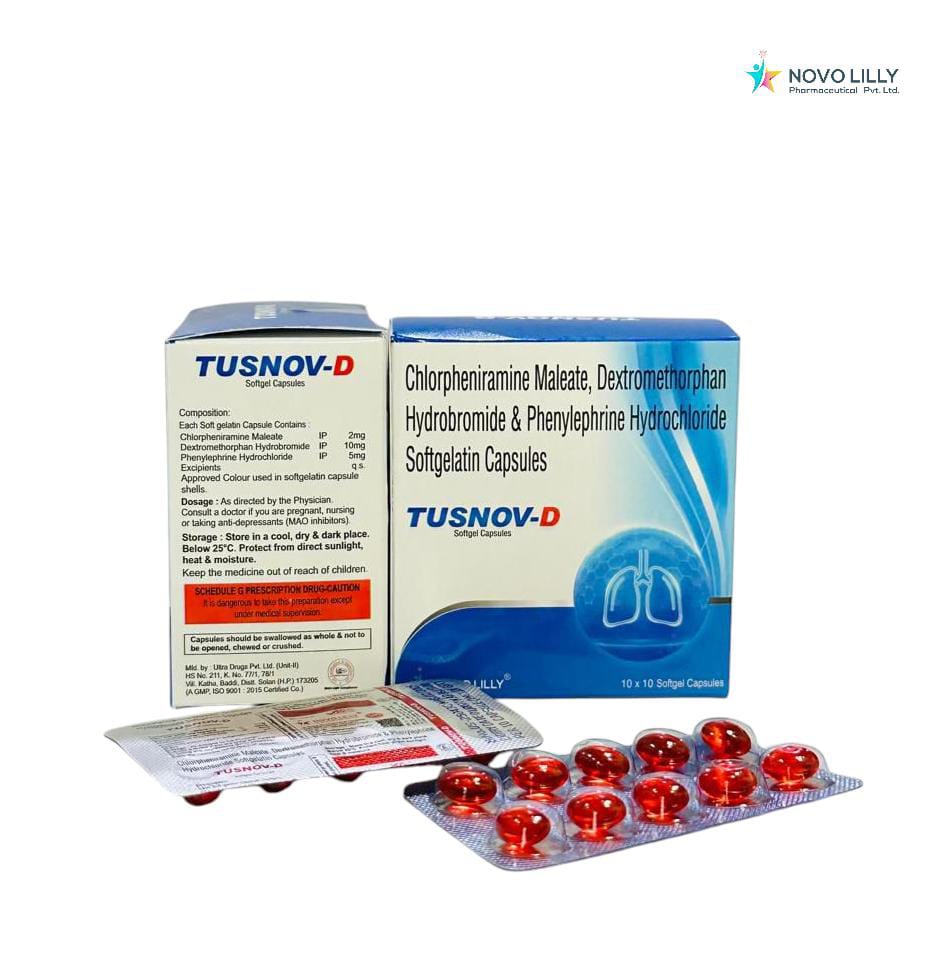
Dextromethorphan HBr 10 MG + Chlorpheniramine Maleate 2 MG + Phenylephrine HCl 5MG Soft Gel Capsules are formulated as a multi-active oral dosage form combining three pharmaceutical ingredients within a single soft gelatin capsule. The formulation requires careful consideration of active compatibility, fill composition, capsule shell characteristics, and dose uniformity during product development. For companies building a diversified PCD Pharma Franchise portfolio, such combination formulations can be developed with a strong focus on standardized manufacturing and consistent product presentation.
Softgel technology provides a distinctive dosage-form platform in which the selected formulation is enclosed within a gelatin-based shell. The internal fill may be designed according to the physicochemical characteristics of the active ingredients and selected excipients. Since the three ingredients can have different material properties, formulation development focuses on achieving a homogeneous fill with suitable physical characteristics throughout processing.
The supplied strength contains Dextromethorphan HBr at 10 MG, Chlorpheniramine Maleate at 2 MG, and Phenylephrine HCl at 5MG per capsule. Maintaining the specified ratio between these components is an important aspect of batch manufacturing. Development work therefore considers weighing accuracy, material handling, blend uniformity, and appropriate in-process controls.
The relatively different quantities of the three active ingredients make uniform distribution an important formulation consideration. During development, each material can be evaluated for particle characteristics, bulk density, flow behavior, solubility, and compatibility with the selected excipient system. These properties influence how the ingredients are incorporated into the softgel fill.
Particular attention is required for the lower-strength Chlorpheniramine Maleate component because smaller quantities can require additional controls to achieve representative distribution throughout the batch. Depending on the formulation approach, controlled premixing or geometric dilution techniques may be considered before incorporation into the final fill system.
Dextromethorphan HBr and Phenylephrine HCl also need to remain adequately dispersed or dissolved according to the selected formulation design. The fill matrix should demonstrate appropriate homogeneity while maintaining physical characteristics suitable for encapsulation. Mixing time, temperature, agitation, and order of ingredient addition may be established during process development to support reproducible manufacturing.
Sampling procedures should be designed to verify that the finished blend or fill material remains representative from beginning to end of the production process. This helps establish consistency between individual capsules and across different manufacturing batches.
Soft gelatin capsule manufacturing involves coordinated preparation of the fill material and gelatin shell. The gelatin mass is prepared with suitable plasticizing and processing components, while the internal fill is maintained within predefined process conditions. During encapsulation, accurate dosing and proper sealing are essential for producing capsules with consistent dimensions and fill weight.
Encapsulation parameters can include ribbon thickness, die-roll settings, fill volume, sealing pressure, machine speed, and drying conditions. These parameters are adjusted during process development according to the characteristics of the formulation and capsule size. Proper synchronization between fill delivery and shell formation helps maintain consistent capsule weight and appearance.
After encapsulation, controlled drying is generally required to establish suitable shell strength and moisture characteristics. Excessive or insufficient drying can affect capsule appearance, flexibility, and physical integrity. Finished capsules may therefore be examined for weight variation, dimensions, surface defects, leakage, sealing quality, and overall appearance.
The final capsule shell and fill system should also remain compatible during storage. Packaging selection consequently becomes an important part of the overall product development process rather than simply a final production step.
Quality control for Dextromethorphan HBr 10 MG + Chlorpheniramine Maleate 2 MG + Phenylephrine HCl 5MG Soft Gel Capsules involves assessment of both physical and chemical characteristics. Depending on the approved product specification, analytical testing may include identification and assay of individual active ingredients, uniformity of dosage units, dissolution-related parameters, moisture characteristics, and other applicable quality attributes.
Because the formulation contains three active pharmaceutical ingredients, analytical methods need to provide suitable selectivity for each component. Method development and validation are important for obtaining reliable results when multiple ingredients are present within the same dosage form.
In-process checks can include fill-weight monitoring, capsule appearance, shell dimensions, sealing quality, and environmental controls during manufacturing. Finished-product evaluation provides an additional verification stage before batch release.
Documentation is also central to pharmaceutical manufacturing. Batch manufacturing records, material traceability, equipment cleaning records, analytical results, and packaging records help establish a controlled production history for each batch. Consistent documentation supports reproducibility and facilitates quality review throughout the product lifecycle.
Stability planning for softgel capsules considers the interaction between the active formulation, gelatin shell, excipients, and packaging system. Temperature, humidity, light exposure, and storage duration can influence physical and chemical characteristics. Stability studies can therefore be designed to evaluate parameters such as appearance, assay, degradation-related attributes, moisture, capsule integrity, and other approved specifications over the intended shelf-life.
Packaging should provide an appropriate barrier against environmental factors that may affect the capsule. Depending on the selected pack configuration, blister or strip packaging can be evaluated for moisture protection, sealing performance, mechanical protection, and compatibility with the softgel shell.
From a product-development perspective, Dextromethorphan HBr 10 MG + Chlorpheniramine Maleate 2 MG + Phenylephrine HCl 5MG Soft Gel Capsules can be positioned within a broader pharmaceutical portfolio where formulation consistency, professional packaging, and documented quality processes are important. For a PCD Pharma Franchise product range, standardized product specifications and reliable batch-to-batch manufacturing can support organized portfolio management.
A well-developed softgel product ultimately depends on coordinated control of raw materials, formulation design, encapsulation parameters, analytical testing, packaging compatibility, and stability performance. These elements together help establish a consistent pharmaceutical dosage form suitable for structured commercial distribution.
Dextromethorphan HBr, Chlorpheniramine Maleate & Phenylephrine HCl softgel capsules with focus on formulation, quality, stability and packaging.