
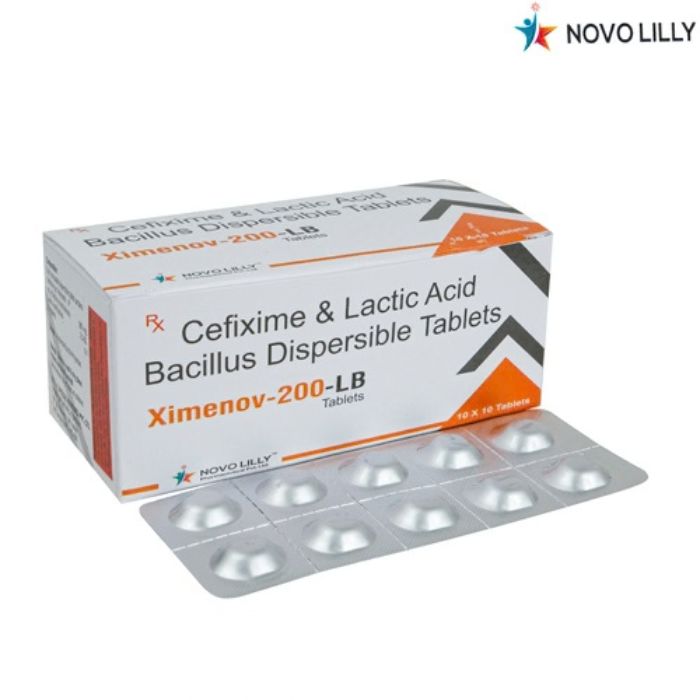
Cefixime 200 MG Lactic Acid Bacillus Tablets are a combination solid oral dosage form containing Cefixime at 200 MG together with Lactic Acid Bacillus in a single tablet. Developing this type of formulation requires careful coordination between conventional pharmaceutical tablet processing and the handling requirements of the biological component. Active-ingredient uniformity, powder characteristics, compression behavior, moisture management, and product stability are important considerations throughout development. For companies expanding a PCD Pharma Franchise portfolio, this combination can be incorporated into a structured tablet range with defined manufacturing and quality specifications.
Cefixime and Lactic Acid Bacillus have different formulation characteristics and therefore require appropriate material-handling strategies. The exact quantity or viable count specification of Lactic Acid Bacillus should follow the approved product composition. Similarly, all excipients should be selected according to the finalized formulation rather than assumed from the active ingredients.
Maintaining the specified 200 MG Cefixime strength while preserving the quality attributes of Lactic Acid Bacillus requires controlled processing conditions from dispensing through compression and packaging.
The formulation contains two fundamentally different types of components: a pharmaceutical active ingredient and a biological preparation. Their individual physical properties can influence powder blending, compression, and storage behavior.
Cefixime may be evaluated for particle size, density, flowability, moisture, and compressibility. Lactic Acid Bacillus material requires additional consideration regarding viable-cell preservation and exposure to environmental conditions during processing.
The blending strategy should therefore be designed to achieve adequate distribution without exposing the biological component to unnecessary mechanical or environmental stress. Controlled premixing and an appropriately established addition sequence may be considered during formulation development.
Low-dose biological components can require careful distribution within the larger powder blend. Geometric dilution or staged blending may be evaluated where appropriate to improve uniformity. Mixing intensity and duration should be established through process studies rather than relying on a generic blending time.
Moisture is another important consideration. Excessive humidity may influence both powder properties and the stability of the biological component. Controlled environmental conditions, suitable raw-material storage, and appropriate processing practices can help maintain the intended quality characteristics.
Representative sampling from the final blend can be used to assess uniformity before compression. This provides an additional process-control step for a formulation containing components with different material characteristics.
Once the final blend meets the established requirements, it is compressed into tablets using suitable tooling and controlled machine parameters. Compression force, tablet weight, thickness, hardness, and press speed can be optimized according to the formulation's physical characteristics.
The compression process needs to provide adequate tablet strength while minimizing unnecessary stress on the Lactic Acid Bacillus component. Excessive mechanical force or unsuitable processing conditions may affect formulation performance, so compression parameters should be established during product development.
In-process checks can include tablet weight, weight variation, thickness, hardness, friability, appearance, and other applicable physical attributes. These measurements help maintain consistency during the compression stage.
If a coating is included in the approved formulation, the coating process should be evaluated carefully for compatibility with the complete tablet. Coating conditions such as temperature, spray rate, drying conditions, and weight gain can be controlled according to the established process.
Packaging immediately after manufacturing may also be important for formulations containing a biological component. Minimizing unnecessary exposure to environmental conditions can support maintenance of the intended product quality.
Quality control for Cefixime 200 MG Lactic Acid Bacillus Tablets requires separate consideration of the pharmaceutical and biological components. Cefixime can be evaluated through appropriate identification and assay procedures, while Lactic Acid Bacillus can be assessed according to the approved viable-count or microbiological specification.
The analytical approach should be appropriate for the individual components and capable of providing reliable results within the finished tablet matrix. For the biological component, suitable microbiological procedures can be used according to the finalized product specification.
Physical testing may include appearance, average weight, weight variation, hardness, friability, disintegration, dissolution, and moisture-related parameters where applicable. The exact testing panel should follow the approved product specification.
Environmental and storage controls can be particularly relevant to maintaining the quality of Lactic Acid Bacillus. Temperature and moisture exposure should be considered during manufacturing, packaging, warehousing, and transportation.
Batch documentation should record the source and specifications of the biological component, Cefixime quantity, manufacturing parameters, analytical results, environmental controls where applicable, and packaging details. This documentation provides traceability throughout the product lifecycle.
The combination of chemical and microbiological testing helps establish that both components remain within their defined specifications before batch release.
Packaging plays a significant role in protecting Cefixime 200 MG Lactic Acid Bacillus Tablets from environmental exposure. The selected packaging system should be evaluated for moisture-barrier performance, protection during transportation, closure or seal integrity, and compatibility with the tablet.
Blister or strip packaging may be considered according to the approved product design. Packaging materials should provide suitable protection against humidity and other environmental factors that may influence the stability of the biological component.
Stability studies can monitor Cefixime assay, Lactic Acid Bacillus viability, tablet appearance, physical characteristics, moisture, dissolution or disintegration where applicable, and packaging integrity over the defined storage period.
The stability program can help establish how the combination behaves under specified storage conditions and whether the packaging system provides sufficient protection throughout the intended shelf life.
For companies developing a PCD Pharma Franchise portfolio, Cefixime 200 MG Lactic Acid Bacillus Tablets can be positioned within a broader combination-tablet range supported by standardized specifications, controlled manufacturing, appropriate packaging, and documented quality procedures.
The development of this formulation therefore requires more than conventional tablet compression. Active-ingredient uniformity, biological-component handling, moisture control, compression conditions, microbiological evaluation, packaging protection, and stability monitoring must work together. Careful coordination of these parameters supports a consistent combination tablet with defined pharmaceutical and microbiological quality characteristics.
Cefixime 200MG Lactic Acid Bacillus Tablets with focus on formulation, quality control, stability, packaging and manufacturing.