
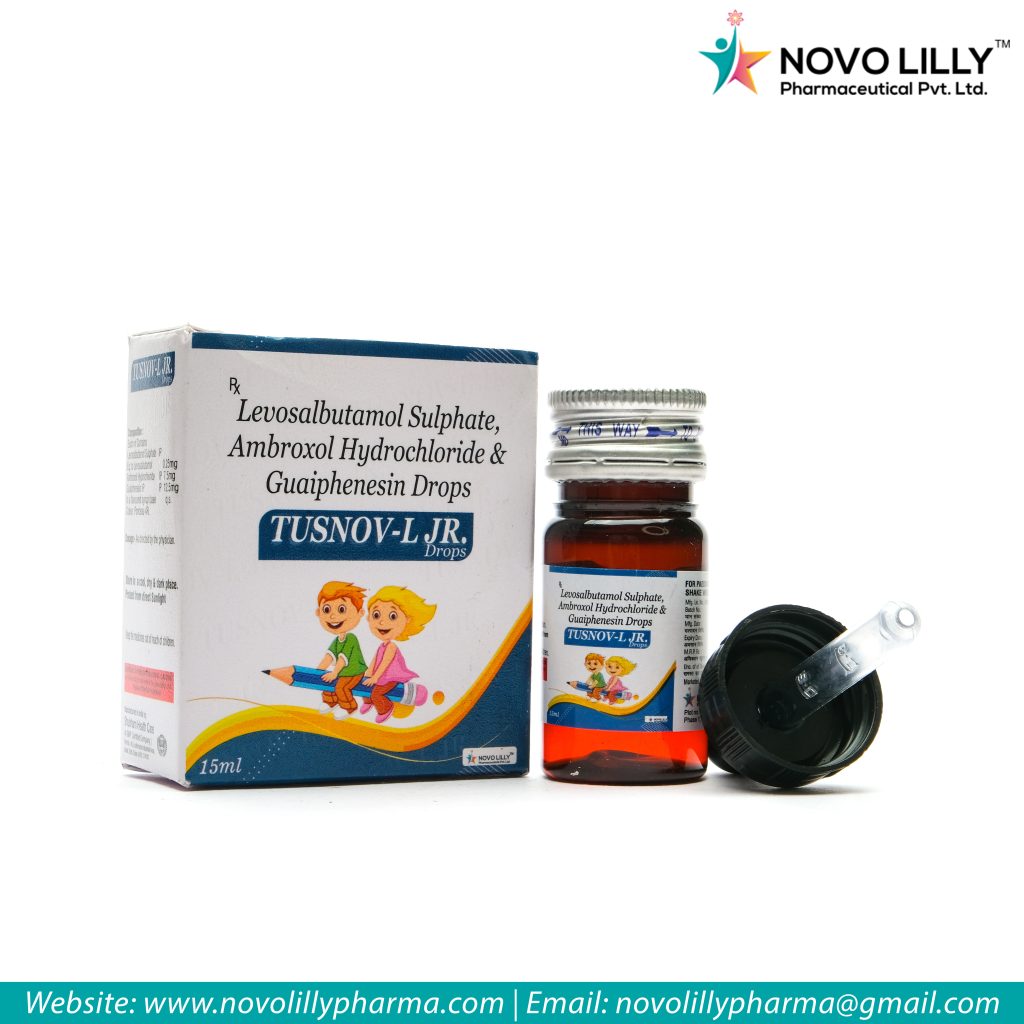
Envision the power of three pharmaceutical ingredients, all working in tandem with each other. Now imagine the formulation, set in concentrated oral drop form. Levosalbutamol Sulphate IP 0.25 MG Ambroxol Hydrochloride 7.5MG Guaiphenesin IP 12.5MG is quite a delicate pharmaceutical process to perfect.
By ensuring the active-ingredient concentration, liquid uniformity, pH range, viscosity, microbial quality and dispensing accuracy is thought out to the fullest. For pharmaceutical companies seeking to add in a PCD Pharma Franchise, standardizing this is a choice that can lead to numerous other premium-level oral liquid production.
Formulation In each dose, Levosalbutamol Sulphate IP 0.25 MG, Ambroxol Hydrochloride 7.5MG, Guaiphenesin IP 12.5MG are accurately weighed. The different strengths of the ingredients necessitate accurate weighing, controlled dispersion or dissolution and integrated batch mixing during formulation development.
IP: Levosalbutamol Sulphate & Guaiphenesin The "IP" marking on Levosalbutamol Sulphate and Guaiphenesin products indicates the quality of their compliance to the highly regarded Indian Pharmacopoeia standards. The product's all-inclusive testing and approved formulation makes up the integrity of the end product.
Formulating with a trio of Actives is a skill in itself. Levosalbutamol Sulphate, even at a relatively low strength versus Ambroxol Hydrochloride and Guaiphenesin, calls for thorough material accounting when preparing the batch.
Formulation development is concerned with assessing the solubility, particle sizes, compatibility and interactions within the selected vehicle. Whether the powders are dissolved separately, in sequence, or in a controlled fashion into the primary vehicle, uniform mixing in the batch is the goal. Good mixing is the facilitator.
Ingredient addition order is designed to prevent localized concentration gradients or interaction. Mixing speed and duration are specific to the batch size and the physical characteristics of the formulation.
Representative samples are vital for multi-component drops. Samples taken from the appropriate areas of the vessel used in manufacturing demonstrate the homogeneity of the liquid and provide confidence in the consistency of the liquid from individual containers.
Oral drops are centered around concentrated products and controlled dispense closures, rather than the familiar syrup. The physical attributes of the liquid should also suit the dropper or dispensing closure.
Viscosity is also critical, too viscous to package, too little to package this also affects the doses. The development process of the formulation determines the value of the ideal viscosity for the chosen container-closure system.
The liquid vehicle contains approved excipients to facilitate solubility, taste, preservation, pH adjustment and stability. The precise composition of excipients is dependant on the final product specification – not assumptions based on the API.
The pH assessment is essential for formulation development and the quality control process. An optimum pH will promote the compatibility of the active ingredients, excipients, and packaging materials. The visual properties (e.g. Appearance, colour, uniformity and presence of extraneous matter) are observed as specified in the approved specifications.
The dropper system is tested for delivery uniformity through a variety of test methods. Orifice sizes, seals, container position and flow features determine the accuracy of the drop.
The manufacturing process moves through an initial phase where each raw material is verified and carefully measured for withdrawal, according to the batch formula. The chemicals undergo processing, i.e. pharmaceutical grade water, along with other excipients.
It is a sequential process involving vehicle preparation, active ingredient addition, added in carefully controlled conditions, mixing, volume adjustments, adjustment of the pH to a suitable level, and filtration or processing. All of this is according to the validated formulation and manufacturing process.
In-process controls include appearance, pH, viscosity, volume of each batch, and various predetermined characteristics. Finished-product testing includes identity and assay of actives, parameters involving uniformity, microbial content, fill volume and dispense characteristics, among others.
When multiple active ingredients are present together, each analytical approach should be able to separate and quantify the individual components. Analysis should be stability indicating and will track changes throughout the product's alloted shelf-life.
All raw-material information, b…atch size, and records of the state ofthe equipment, intermediate processing steps, laboratory tests, and packaging at the time of completion are recorded. The system guarantees traceability and reproducibility from batch to batch.
The role of packaging is a protector that maintains quality during manufacturing, storage, and distribution. The bottle, the dropper, and the sealing system have been chosen according to the physical and chemical properties of the formulation. Packaging materials must protect the liquid and must be compatible.
The dropper needs to perform throughout the entire lifetime of the product. Closure integrity testing, resistance to leakage, dimensional uniformity, controlled flow rates of the product into the packaging will all contribute to the packaging development.
Stability investigations will study appearance, pH, viscosity, the assay of the active ingredient, microbial quality, volume of filling, and performance during dispensing, for specified storage conditions. Compatibility testing of packaging gives them the information about the modification in composition caused due to long interaction of formulation with packaging material components.
As companies enhance their PCD Pharma Franchise portfolio for Levosalbutamol Sulphate IP 0.25 MG + Ambroxol Hydrochloride 7.5MG + Guaiphenesin IP 12.5MG Drops in the coming years, the product should be able to offer a backbone to any set of well-structured oral-liquid products. Harmonized products require formulation consistency, proper packaging, manufacturing, and quality testing.
The complete and successful formulation process for these multi-active drops will require a collaborative team effort in: with raw-material dispense-ability, with liquid-processing, with active-uniformity, with viscosity, with dropper-function, with official analysis, with packaging, and with stability. These simultaneous controls will lead to a uniform pharmaceutical oral-drop dosage form suitable for professional product development and distribution.
Levosalbutamol, Ambroxol Hydrochloride and Guaiphenesin drops with focus on formulation, manufacturing, quality control, packaging and stability.