
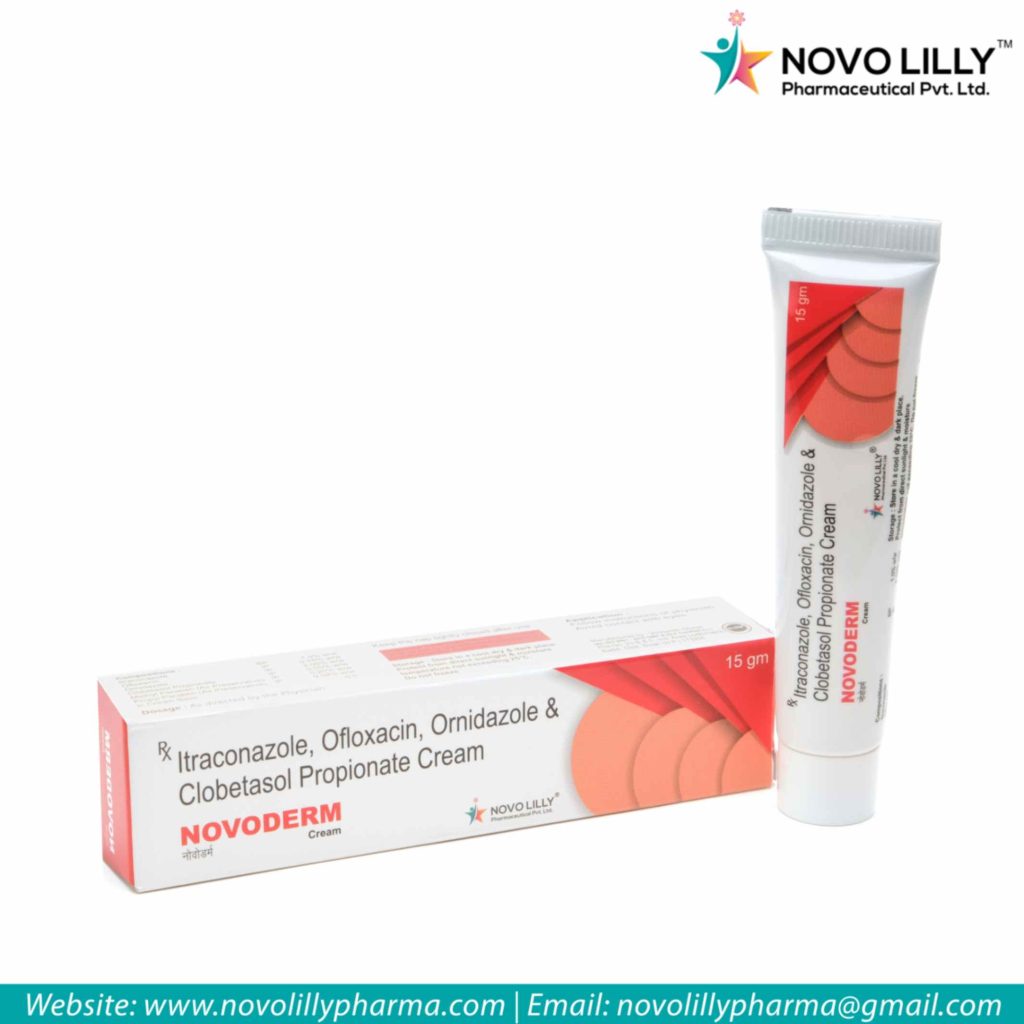
Ofloxacin 0.75% W/W + Ornidazole 2% W/W + Itraconazole 1% W/W + Clobetasol Propionate 0.05% W/W Cream Complex (in Semisolid Format) An advanced topical composition comprising four pharmaceutical substances embedded in a well-designed semisolid base to create an intricate formulation. Since the cream contains both pharmaceutical substances with dissimilar physicochemical properties and potentially varying concentrations of the pharmaceutical substances, formulation experts create a formulation through dispersion, compatibility testing, and uniform distribution. For pharma entrepreneurs who want to expand their topical selection of products, this cream composition can be introduced in a well-designed PCD Pharma Franchise range, focusing on quality assurance, formulating competency, stability, and professional packaging.
Selection of Ingredients The initial step in manufacturing this cream is to choose a ready-to-use semisolid base, which should be compatible with the formulation's active ingredients and also have a consistent texture. Ofloxacin, ornidazole, itraconazole, and clobetasol propionate have different formulation properties, thus compatibility evaluation is a key step in product development.
The cream base can be formulated to be of an appropriate consistency, spread ability and physical stability. In the final formulation of this product, the ingredients may need to be incorporated at different stages for proper distribution. The relatively low dose of the clobetasol propionate means dispersion is very important.
The choice of excipient is made with active compatibility in mind, and the base structure, pH (if relevant), viscosity, and physical stability should all be factored into the decision. The end formulation should be stable and remain uniform without delamination, crystallization, or change of the texture.
Complex formulation challenges for uniform distribution of multiple actives Since many active ingredients are incorporated into the product, from a technological perspective, one of the major challenges is uniform distribution of these actives. Each active can exhibit specific particle sizes, solubility behavior and be present in various interactions with the base cream. where an active is included as a dispersed phase, controlling particle size properties and proper wetting can contribute towards obtaining a uniform product. When used at low dose, particular care is required with regard to pre-mix, and even dispersing, so that sampling a representative amount of the finished cream gives the correct dose.
The process route may involve the preproduction of the compatible active phases and then a precise addition to the main base. Homogenization conditions including mixing conditions, time, temperature, order of addition, etc. are standardized based on the formulation. The aim is to make a smooth and uniform cream with reproducible active distribution in the whole production batch.
The physical behavior of a topical cream is governed by the composition of the base and the way ingredients are accommodated within this base. Rheological properties are hence also important quality parameters for characterization at development stage.
Properties like consistency, consistency, spread ability, appearance, color, homogeneity can be determined to decide the product specifications which are required. Product should be of the same consistency during filling, storage, transportation and other handling conditions.
Temperature may also affect the behavior of the semisolid. Accordingly, manufacturing parameters are monitored to avoid excessive changes to viscosity or base structure. This may include taking account of the cooling profile (where applicable) in process development.
An acceptable formulation has a stable semisolid consistency and performs under the practice of filling into the designated primary pack.
Analytical methods for quality control of this four-active cream This cream formulation must undergo analysis in order to be assessed and to identify the various components in order to establish the overall quality of the product. Analytical method development Quality control Analyzed Formulation Standards
Finished-product tests may be used for identification and assay of individual active components, physical appearance, homogeneity, viscosity, pH where relevant, microbial quality, and other parameters specific to the formulation.
Sampling procedures matter as a semisolid product needs to be representative of the whole batch. Samples taken from locations that are well defined can be examined to ensure that the active distribution is uniform.
In-process controls include tracking bulk appearance, temperature, mixing speed and temperature, viscosity and other important properties. Recording all the production process details helps trace, recopy and reproduce the batch.
The stability of this cream will be assessed to observe any alteration in the active substances and physical characteristics of the semisolid base. This may cover the appearance, viscosity, phase separation, odor, color, pH (if used), assay, microbial quality, and other relevant specifications.
Certain compatibility of package is especially critical because creams may have long storage times and there could be some interaction with the container. Compatibility of container with the formulation and resistance to leakage or distortion are evaluated.
The packaging system must also offer the lowest level of exposure possible when exposed to any factor that might cause damage to the product. Good closure performance takes care of the cream in transit and during storage.
The label should clearly display the product name, composition, potency, batch details, manufacturing info, expiry information, storage conditions and other relevant regulatory information.
Final formulation: ofloxacin 0.75% W/W + ornidazole 2% W/W + itraconazole 1% W/W + clobetasol propionate 0.05% W/W cream .This is a very technically complex multi-active topical, where compatibility, uniformity, semisolid consistency, analytical control and stability are inseparable issues.
Some pharmaceutical companies who are planning to make a diversified PCD Pharma Franchise product portfolio can manufacture the formulation with a primary focus on standardized manufacturing and specification. Starting from raw material qualification and active premixing to homogenization, filling, quality testing, stability assessment, and final packaging, it contributes to the quality profile of the end product.
A systematic development strategy ensures that the specified level of all four active substances are maintained and that physical properties are maintained from batch to batch. Suitable documentation, validated or qualified analytical procedures, controlled process parameters and suitable packaging provides additional stability to the overall product-development structure.
Ofloxacin, Ornidazole, Itraconazole, Clobetasol cream with formulation, manufacturing, quality control, stability and packaging details.