
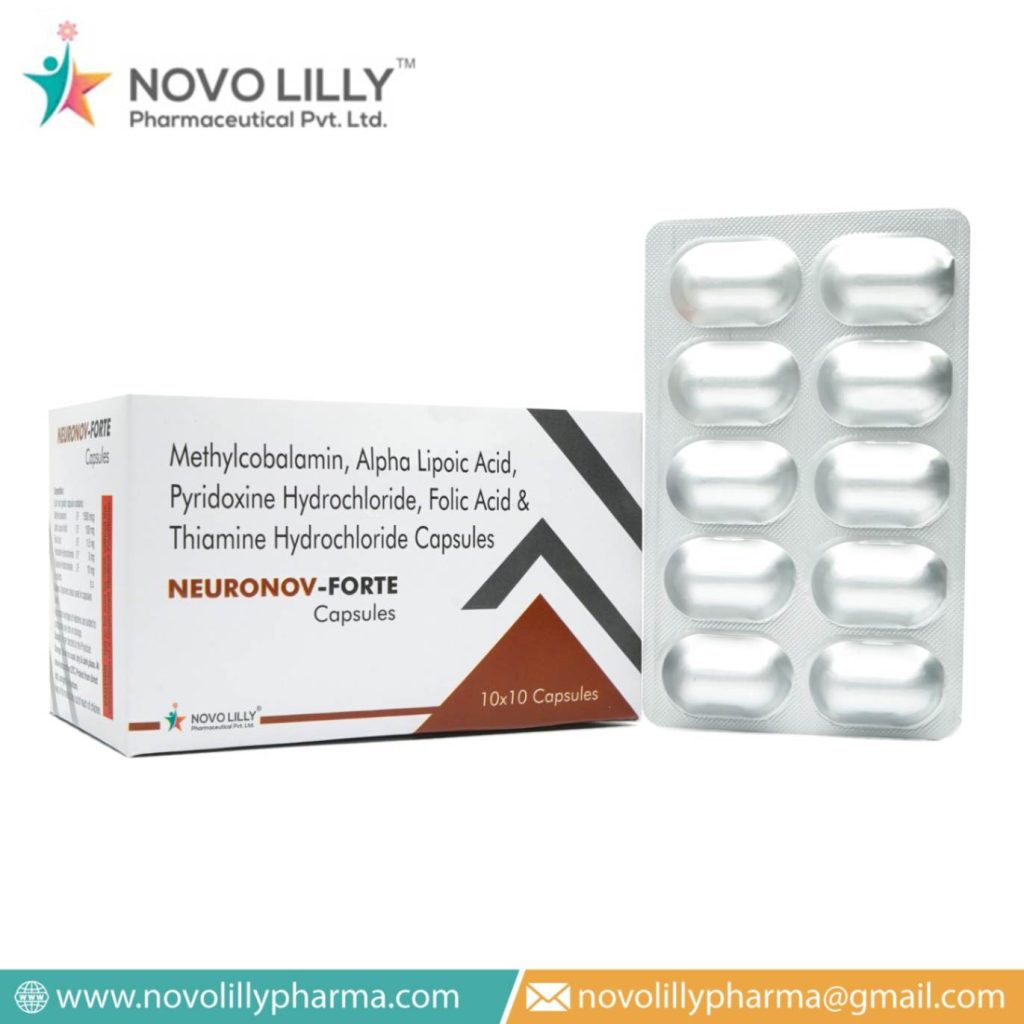
Methylcobalamin 1500 MCG + Alpha Lipoic Acid 100 MG + Folic Acid 1.5 MG + Pyridoxine Hydrochloride 3MG + Thiamine Hydrochloride 10MG Capsules Composition: This is a multi-component vitamin and antioxidant ingredient pharmaceutical formulation in the capsule dosage form of Vitamin. This multi-ingredient product formulation contains ingredients of the products in proportions of different strengths, thus dispensing, premix preparation and blend uniformity requirements are an important part of product development. This multi-ingredient combination can be used as part of a professionally structured PCD Pharma Franchise Product Line for the pharmaceutical industry as a product with different strength strengths with quality as well as manufacturing controls.
In order to mix the ingredients for the formulation, the physical properties of all ingredients, such as particle size, density and flowability (ability to flow or stick together, for example, in a heap or on a surface) are considered.
The drug has methylcobalamin of 1500 MCG, and alpha lipoic acid of 100 MG, folic acid of 1.5 MG, pyridoxine hydrochloride of 3MG, and thiamine hydrochloride of 10MG. The variation of the number of components is so wide and significant that it demands a strategic implementation of the material handling.
Prior to manufacturing, individual raw materials are tested in terms of physical properties and fit with the chosen excipient system. Excipients may be added to aid powder flow, improve flow and blend characteristics and for ease of capsule filling.
Ingredients at a low dose-methylcobalamin, folic acid-are especially sensitive to dispensing and blending. These low-dose ingredients can be dispersed into a larger carrier matrix in a suitably prepared premix, or through a geometric-dilution step, prior to blend.
The weight of each ingredient is set in accordance with the approved formulation specification, with file documentation and material identification retained. Controlled dispensing is the basic system that supports the composition of the finished capsule.
A major manufacturing issue for this formulation is to give a uniform distribution of the high-quantity and low-quantity ingredients. It is not always possible to distribute the microgram components into the whole batch of formulation directly, hence there is a half-way premix step involved in formulation development.
The low dose ingredients can then be weighed out and accurately blended with an appropriate vehicle, or a proportion of the larger powder blend, prior to being dispersed into the main blend. The precise method varies according to particle size, bulk density and production machinery used.
Additionally, alpha lipoic acid must be manufactured with consideration for the formulation development since its physical and stability properties can impact on processing and packaging. The final mixture is tested for flowability, bulk density and segregation resistant.
Blending time, addition sequence and equipment loading are monitored to plant process specifications. Representative sampling from various locations in the blend may be analyzed to assess the formulation distribution prior to capsule filling.
When the blend reaches the optimum required homogeneity, it is transferred to the final capsule-filling process. The type of powder properties of the formulation can affect machine operation and capsule filling and closing.
The size of the capsule is determined by the total fill weight and physical density of the formulation. Equipment is then fine-tuned to ensure accurate powder fill weights of each capsule shell.
In-process checks could be average fill weight, weight variation, shell integrity and visual appearance and capsule locking. In-process checks can help to identify variations in the course of manufacture and permit a uniform finished-unit high quality.
Post filling, capsules are sent for dedusting, sorting and inspection and then to the packaging section. Controlled handling reduces powder leakage and shell breakage and/or damage.
Environmental conditions are also taken into account during manufacturing as some vitamin and antioxidant ingredients are prone to moisture, oxygen or light. Good processing conditions can thus help to ensure product quality.
For this formulation, quality testing necessitates an assessment of a few ingredients with varied strength. Analytical techniques should be effective to test methylcobalamin, alpha lipoic acid, folic acid, pyridoxine hydrochloride, and thiamine hydrochloride as per the product approved specification.
Certificate of analysis testing for content and content uniformity can confirm that each component is present and at what level. Subject to the specification, finished capsules can be tested for average weight, uniformity, disintegration, dissolution and other physical characteristics.
The analytical methods used must be sensitive enough to detect the less potent ingredients (methylcobalamin and folic acid). Representative sampling is consequently important as lab analysis will be used to infer the entire batch is fit for purpose.
Raw materials, premix preparation, blending, capsule filling, in-process checks, and laboratory results are recorded to provide traceability. A well-organized quality system is essential in providing support during batch release.
Stability is evaluated as a combination of the performance of all vitamins and alpha lipoic acid in the completed capsule formulation. Some ingredients may be affected by moisture, oxygen, temperature or light at different rates and packaging can influence product development.
Packaging forms, such as blister packs, strip packs or any other suitable pharmaceutical packs can be assessed against the final formulation and stability specifications. The choice of packaging materials should afford the proper protection of the product and maintain the capsule integrity during its shelf life.
The stability study involves testing assay, appearance, physical integrity and other relevant quality parameters at predetermined intervals. Compatibility of the packaging system and integrity of the seals are also studied to guarantee that the packaging system chosen is appropriate for the product throughout the proposed shelf life.
Pharmaceutical Companies may add Methylcobalamin 1500 MCG + Alpha Lipoic Acid 100 MG + Folic Acid 1.5 MG + Pyridoxine Hydrochloride 3MG + Thiamine Hydrochloride 10MG Capsules can be a part of the PCD Pharma Franchise product list if you are a company in the pharma line. Normal premix manufacturing, regulated capsule filling, delicate analytical testing and appropriate protective packaging result in a product of uniform quality.
In sum, this formulation provides a blend of several nutritional actives with significantly varying concentration levels. As a result, its processing requires precise dispensary, premix design, blending consistency, cap-filling precision, multi-analyte analysis, stability testing and packaging. Such clearly-defined controls at each of these stages enable reproducible production and final-product consistency.
Amoxicillin 250mg with Clavulanic Acid 125mg Tablets featuring formulation, manufacturing, quality control, stability and PCD Pharma details.