
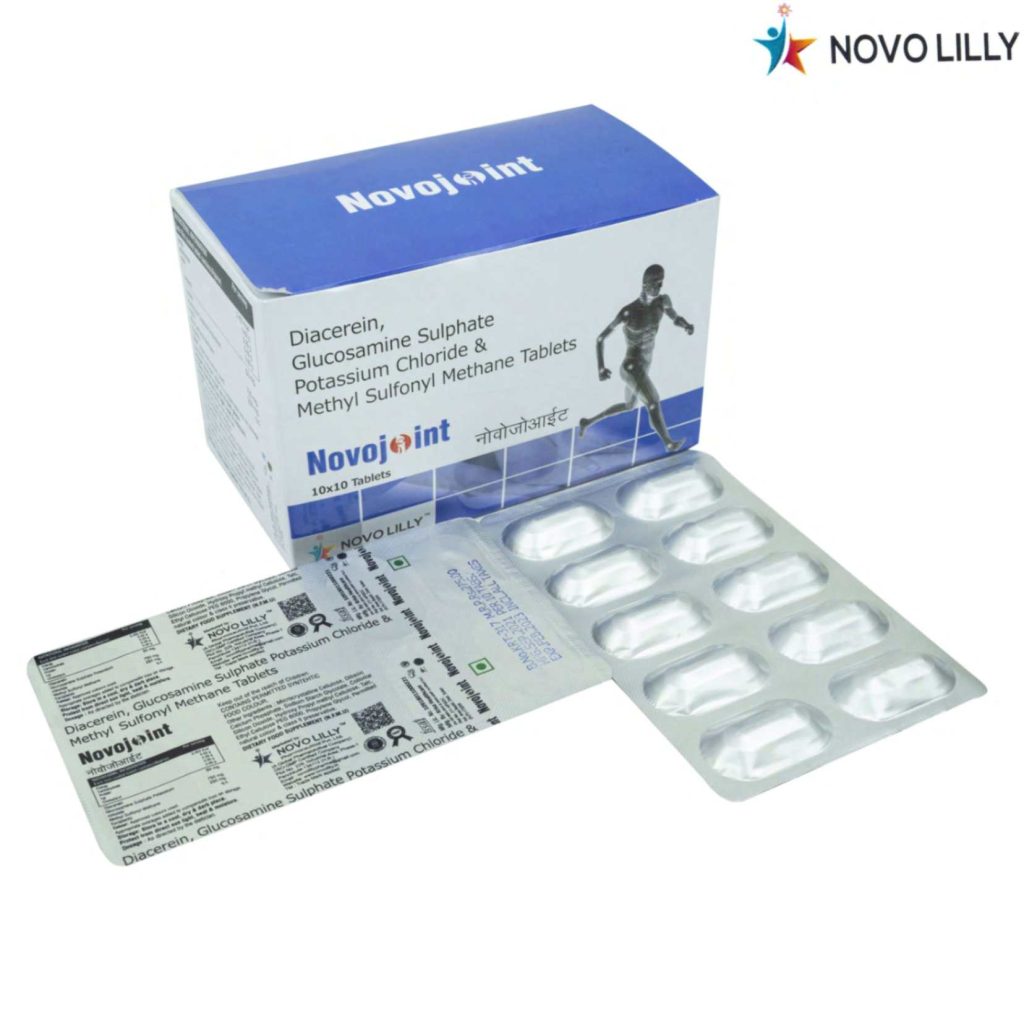
Diacerein 50mg, Glucosamine 446mg, Methylsulphonylmethane 250mg One-part pharmaceutical oral dosage form for use in combination, having an active ingredient of relatively low strength in contrast to formulation and supplement/excipient components. The compounding ratios and physical form of the different ingredients require attention to blend uniformity, powder flow and particle characteristics, together with the manufacturing sequence and final solid dosage form when designing the finished product. When considering new formulation ranges for the pharmaceutical franchise market – this can be integrated into a quality PCD Pharma Franchise line.
The initial stage of the formulation is the assessment of the three active ingredients as discrete entities and the physical properties of each. The ratio of active ingredients to each other is very different with diacerein at 50mg and glucosamine at 446mg and methylsulphonylmethane at 250mg being a significant volume of the total active load.
Particle size, bulk density, flow properties, moisture characteristics and compatibility are assessed during development. Particle-size adjustment and pre-blending of some ingredients can be used, if appropriate, to optimise the behaviour of the complete powder mixture.
The excipients are chosen based on the required dosage form and the compatibility with the actives. The aim is to have a formulation which is physically stable during and after processing (compression or encapsulation) and filling as well as storage.
Among the key technical issues in this combination is the uniform dispersal of the 50mg component of diacerein in a formulation containing much larger amounts of glucosamine and methylsulphonylmethane. Proper mixing method in direct addition is very important to avoid non-uniform dispersal.
Pre blending at a controlled level of the lower quantity component is preferable to pre blending it with the larger quantity component. Product development considerations would require the use of geometric dilution or other pre blending method that has been validated in view of the physical form of the product materials.
Uniformity may be assessed by blend sampling from specific points in the blend. The sampling plan should be able to give representative data on the distribution of all relevant components.
Reproducible manufacturing can be achieved by controlling particle properties and mixing conditions, and segregation in subsequent processing can be reduced as much as possible.
Powder handling has become a significant aspect of the manufacturing process due to the relatively high combined active load. Glucosamine and methylsulphonylmethane may affect the bulk density, flow characteristics, compressibility and blend attributes.
As a result the formulation could be tested for flow characteristics, moisture content, bulk and tapped density and other powder parameters. Such properties can have an impact on hopper flowability, reproducibility of feed, compression or filling, depending on your tool of choice.
The formulation design determines the process parameters, such as blending time, sequence of mixing, volume of the equipment, and conditions for transfer. The mixture may be subjected to overflow or under flow, then segregate due to mishandling or uncontrolled movement.
In-process Checks may also include Blend Uniformity, Weight Variation, Physical Description, as well as other parameters specific to dosage form.
Accurate measuring of the individual active ingredients is important in quality control for this three-component drug formulation. The analytical techniques used for quantitative evaluation should be able to deliver adequate sensitivity and specificity for each component.
Finished-product testing may include diacerein, glucosamine, methylsulphonylmethane identification and assay, dosage-unit uniformity, dissolution (as appropriate), physical appearance, moisture content and other specifications.
For formulations containing two or more actives, a validated analytical procedure is crucial. It allows you to reliably separate and quantify multiple actives, and to obtain batch-release data with confidence.
In-process controls and finished-product testing collaborate to validate the manufacturing process, ensuring that every unit produced fulfills the specifications.
Stability testing determines if the formulation maintains it identified specifications throughout the proposed shelf life. For each type of dosage form it can include Assay, dissolution, appearance, moisture, dose-unit uniformity, and other relevant quality criteria.
It could be moisture control is more important during formulation when using multiple powder based actives. It is known that an overexposure to moisture can influence powders and in some formulations can have an impact on physical stability.
The packaging is tailored for the moisture sensitivity and stability profile determined in the development process. Depending on the final form of the drug, blister packs, strips, bottles or other appropriate pharmaceutical packaging systems can be used.
Pre-Commercialization Testing the test can also include container-closure compatibility, seal integrity, safeguarding during transportation and labelling correctness.
Diacerein 50mg, Glucosamine 446mg, Methylsulphonylmethane 250mg A Technical Distinctiveness opportunity exists here where the product combines three ingredients at three different concentrations within one product. Technical success in the development of this product will be driven by managing powder properties, low dose active distribution, blend uniformity, manufacturing performance, assay and stability.
If your company is committed to offer a multi-product PCD Pharma Franchise portfolio, you can add them to a well-structured formulation offer backed by specific standards and documented manufacturing procedures.
Product Consistency Each step in the manufacturing process from raw-material qualification and pre-blending to final dosage-form processing, analytical evaluation, stability studies, and packaging, is designed to ensure product consistency. Proper manufacturing design allows the intended composition and quality attributes of the pharmaceutical product to be maintained within each batch.
Diacerein 50mg, Glucosamine 446mg & Methylsulphonylmethane 250mg formulation with manufacturing, quality control, stability and packaging details.