
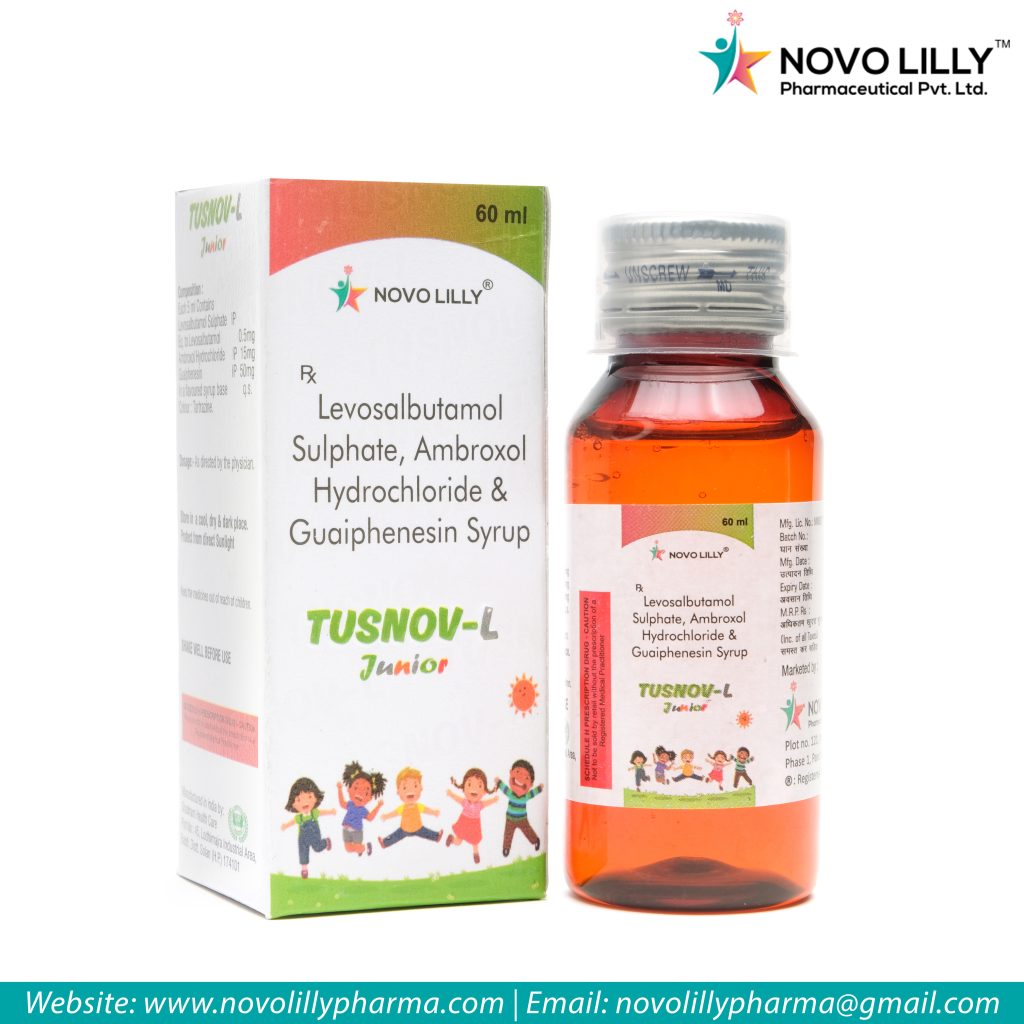
Imagine a syrup that consolidates the trio of formidable ingredients in the best possible way! Let's play a round of ingredient discovery with Levosalbutamol 0.5MG, Ambroxol 15MG, and Guaiphenesin 50MG, good to be made into a king-size oral liquid formulation. But… what is that perfect 'how to' that makes these ingredients perform on the same scale in a single syrup form?
It's coordination that matters, that an on-paper ingredient compatibility, dissolution, and liquid v/s uniformity, matching up on pH, viscosity and taste becomes an absolute necessity!
An organized drug range in the PCD Pharma Franchise model- what is the go-to-maker for? CBD… and more!
The exact formulation of the syrup is 0.5MG of Levosalbutamol 15MG of Ambroxol 50MG of Guaiphenesin per unit. As each of these are prepared in different measures, each must be weighed with great precision during manufacturing and added in a controlled manner.
The trick to mixing Levosalbutamol, Ambroxol and Guaiphenesin Creating a uniform and complete blend of Levosalbutamol, Ambroxol and Guaiphenesin is no trivial matter. Its ingredients are completely different, which is why they require special formulation studies to develop each one to adhere perfectly to a common vehicle. As the ingredients are prepared, raw materials are checked against approved specifications, then combined based on their solubility and compatibility-either individually or sequentially-until a common mix is achieved.
Levosalbutamol, at a lower level than Guaiphenesin, presents more copying and mixing challenges to ensure the mixture remains at the required concentration. Extraction of samples from different points in the batch allows calculation of the blend consistency.
Development is carried out by optimization of process parameters such as mixing time, agitation intensity, temperature, and batch volume. These must be controlled within set limits to avoid discrepancies between batch runs.
The property vehicle is the base upon which the product is to be placed; it impacts the visual attributes of the finished product and affects the flow and consistency of the formulation.
Liquid forms are heavily dependent on viscosity. The viscosity must be within a specific range to afford consistent filling and handling. Changes in viscosity can be caused by formulation changes and need to be monitored during formulation development and stability testing.
PH control may be necessary for formulation compatibility and stability. The flavouring and sweetening should not be in conflict with the active and other excipients.
The end product (syrup) is visually examined for colour, liquidity, consistency, and the presence of any solid matter, part of the standard quality control process.
Preparation of the Manufacturing Liquid vehicle is handled in a controlled manner. Active ingredients and excipients are weighed in accordance with the approved batch formula and added to the manufacturing process in a specific order.
Based on the design, some ingredients might be prepared separately before being combined with the main batch vessel. Controlled mixing proceeds until a set target homogeneity is reached, and then the volume is adjusted to the precise level along with the pH.
In process testing will include pH, viscosity, appearance, and batch volume. Finished product testing will include identity and assay of each active ingredient, microbial quality, and fill volume.
Analytical testing (especially for combination formulations): As each of the three active ingredients needs to be tested individually, appropriate analytical methods need to show accuracy and precision for each.
Another Quality Feature Documentation of all the raw materials, batch manufacturing, equipment status etc, provides another layer of controls and results in complete batch traceability.
Packaging plays an important role in the product development as the container-closure system is in contact with the syrup for its duration. Compatibility of the pharmaceutical bottles and closures, of the system is studied along with resistance to leakage and weather conditions.
The packaging has to maintain the physical and chemical integrity of the syrup during storage and shipment. It has to be considered: material and shape of the container, type of closure, nature of headspace, filling precision and sealing system.
Stability studies monitor different attributes such as physical appearance, pH, viscosity, assay of active ingredients, microbial quality and integrity of the package over the period of time to check whether the formulation remains within the specification at the specified storage condition.
For a PCD Pharma Franchise, uniform packaging and product specification enable it to be blended with other oral-liquid formulations. Consistency from batch to batch, sealed quality measures, and professional appearance are essential as companies prepare new items for organized pharma distribution.
Producing the syrup goes far beyond just mixing the three active ingredients. It is important to consider the many factors, such as the quality of the raw materials, compatibility of formulation, controlled mixing, control of viscosity, testing, packaging options, etc., that must all work together. Follow a systematic approach to support the manufacture and maintain the quality attributes of Levosalbutamol 0.5MG + Ambroxol 15MG + Guaiphenesin 50MG Syrup.
Levosalbutamol 0.5MG, Ambroxol 15MG and Guaiphenesin 50MG syrup with focus on formulation, quality control, packaging and stability.