
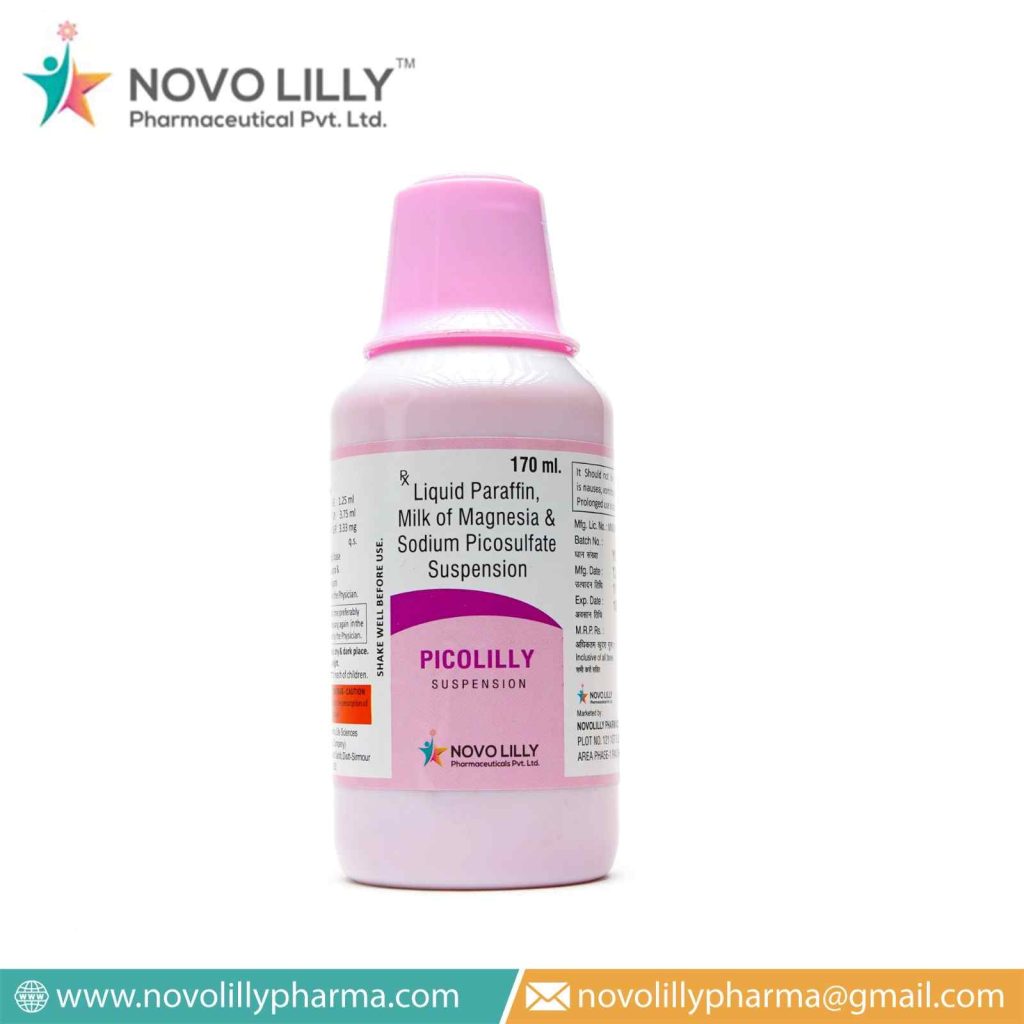
Photo Credit: www.wellblue.com: How to Give Your Child a Successful "Pill Take" See a natural, yet multi-component formulation of Liquid Paraffin 1.25ML, Milk of Magnesia 3.75 ML and Sodium Picosulfate 3.33MG/5ML Suspension, Pharmaceutical manufacturer endeavour to produce it by choosing the right base product, device type, and the formulation structure. Choosing right base product and device type is crucial for commercial success, because pharmaceutical manufactures want to achieve, a small but concentrated selection of qualities like dispersion, viscosity, dose consistency and container compatibility. This structured sort of trade is a hot deal for pharmaceutical companies looking to diversify through PCD Pharma Franchise.
The recipe is a combination of three different ingredients, each with different physical and chemical properties: the oily conduct liquid paraffin; the dispersed phase, milk of magnesia, magnesium hydroxide; and the unassuming but powerful star of the show, sodium picosulfate. Creating a union of these heterogeneous ingredients takes a vessel capable of supporting a homogenous suspension structure.
Due to the lower level of sodium picosulfate, careful attention is given to achieving even distribution. The manufacturing teams use controlled premixing or appropriate dilution methods to avoid concentration variation. The physical properties of the suspension such as viscosity and particle dispersion are monitored to maintain product consistency.
Its composition is selected by choosing suitable excipients and vehicle system. Wetting and dispersion are important for dispersed components and the conditions must be well controlled for liquid paraffin. The manufacturing process may include the initial formation of certain phases and then mixing process may be employed to combine at controlled conditions. The agitation speed, time of mixing, temperature, temperature of addition all contributes to the final structure and the optimum process parameters should be defined during development and scale up.
The last suspension is examined for appearance, consistency, sedimentation and ability to redisperse to determine that the same product is obtained in each batch.
The stability of physico-chemical attributes – an essential feature of multi-component suspensions – encompasses the preservation of viscosity for solid components. By keeping the dispersed medium within the suspension, its physical properties are more stable and could be pumped more efficiently.
Another key attribute is redispersibility. Components in a suspension tend to settle out, depending on their size, density, and vehicle properties. A good formulation will redisperse into a uniform phase with a shake or stir. Formulators measure sedimentation volume, redispersion, viscosity, and clarity in product development and stability testing.
The relationship of the oil-based part and the suspension phase, aqueous portion, can also be considered. It might be expedient to use of help emulsification or dispersion to keep up a steady picture and physical structure.
Liquid Paraffin 1.25ML + Milk of Magnesia 3.75 ML + Sodium Picosulfate 3.33MG/5ML Suspension is manufactured by dosing raw materials, preparing phases, mixing, homogenizing, and filling. There are important requirements for weighing, measurement, especially the components with different concentrations.
Other quality-control tests may consist of ingredient identification and assay, pH testing, viscosity testing, appearance, fill volume testing, sedimentation testing, and redispersibility. Because sodium picosulfate is present at such a low level, an analytical method is needed with high sensitivity and specificity in order to determine content.
Homogeneity checks at different point of the process, prior to filling, which ensures compliance with specifications.
The Container – Packaging is one of the main factors in maintaining the physical quality of an oral suspension. The choice of bottle material, type of closure, headspace, and the dispensing system should all be made on the basis of compatibility considerations. A suitable container prevents contamination and preserves characteristics on storage.
Stability testing includes examining changes in appearance, viscosity, pH, assay, sedimentation, redispersibility, and other measures at specified storage conditions. Compatibility testing looks at the liquid paraffin and interaction with the container material. Packaging-line quality control measures also include checking the fill volume and lock of the closure.
Product identification, batch and manufacturing date, storage conditions and storage test certificate can support traceability along distribution.
Developing a formulation such as Liquid Paraffin 1.25ML + Milk of Magnesia 3.75 ML + Sodium Picosulfate 3.33MG/5ML Suspension necessitates synergistic collaboration between formulation, manufacturing, QC, and packaging departments. Its multi-phase structure necessitates process continuity from raw-material handling to final filling.
For pharmaceutical marketers and franchise distributors, well formulated suspension can be one part of a comprehensive PCD Pharma Franchise portfolio, which may include different dosage forms and product ranges. Clear and standardized formulation, proper packing, document each batch accurately and consistency in manufacturing are effective way to improve product presentation for distributors and business partners. Stability of formulation, reproducibility of manufacture are important considerations for sustainable product management across a distribution network.