
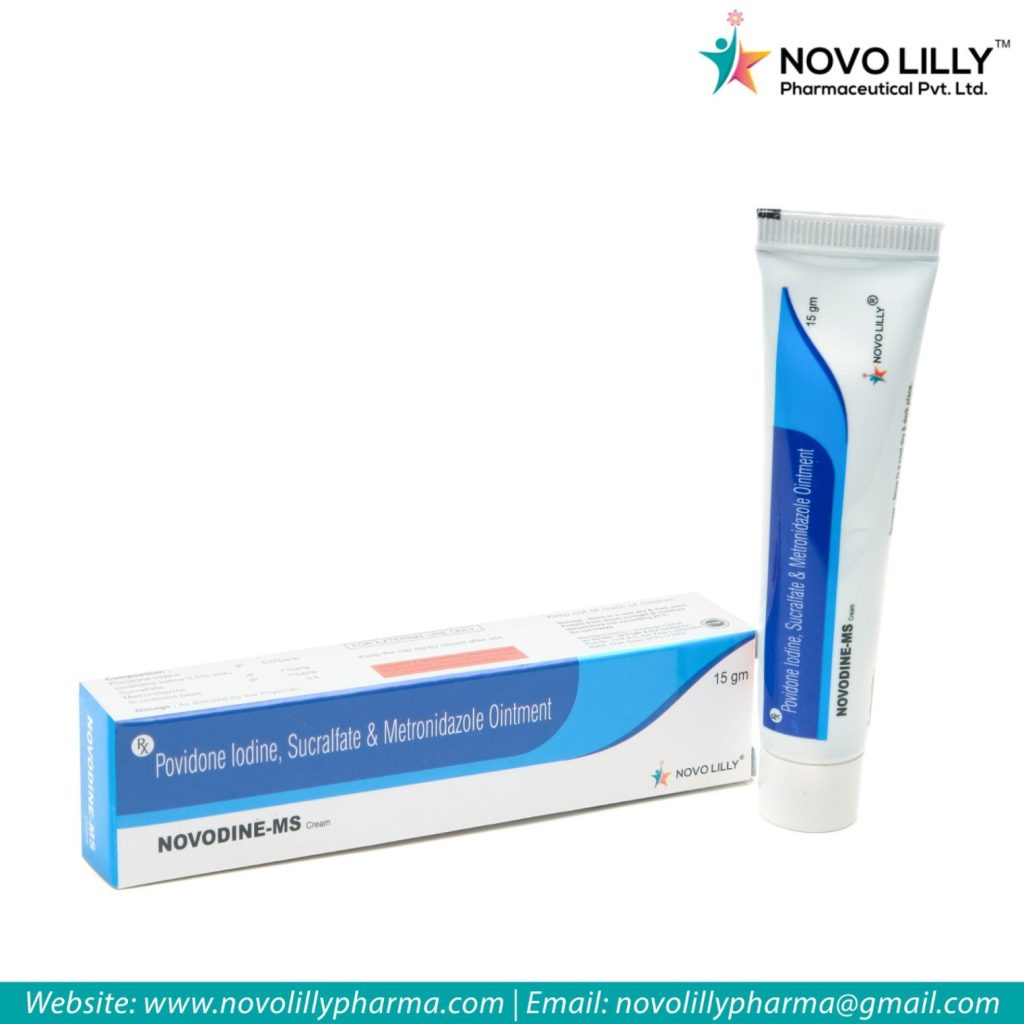
Povidone Iodine, Sucralfate & Metronidazole Ointment is a multi-component topical semisolid formulation combining povidone iodine, sucralfate, and metronidazole within a suitably developed ointment base. Because these ingredients have different physical and chemical characteristics, formulation development requires careful attention to compatibility, dispersion, homogeneity, and stability. The base must support consistent distribution of the active components while maintaining appropriate texture and physical integrity. For pharmaceutical companies expanding their topical portfolio, this formulation can be incorporated into a structured PCD Pharma Franchise range with emphasis on controlled manufacturing, quality specifications, and reliable packaging.
The foundation of this formulation is the selection of an ointment base that can accommodate the three active components without compromising uniformity or physical stability. Base selection depends on the desired consistency, compatibility requirements, moisture characteristics, and final packaging configuration.
Povidone iodine contributes its own formulation considerations because it exists as an iodine complex, while sucralfate has distinct physical characteristics and metronidazole may require controlled dispersion within the selected base. These differences make excipient compatibility an important part of formulation development.
The formulation may involve a carefully balanced combination of suitable base materials, depending on the final product design. Each excipient is evaluated for compatibility with the active ingredients and its contribution to viscosity, spreadability, stability, and overall product texture.
The finished ointment should remain homogeneous and should not demonstrate unwanted phase separation, excessive hardening, or significant changes in consistency during storage.
Uniform distribution of the active components is a central manufacturing consideration. Sucralfate may require controlled particle dispersion, while povidone iodine must be incorporated under conditions that preserve the intended formulation characteristics.
The manufacturing process can involve separate preparation or pre-mixing of selected components before their gradual incorporation into the ointment base. Particle size, wetting characteristics, mixing sequence, and processing time can influence the final homogeneity of the product.
Controlled homogenization helps distribute the active materials throughout the semisolid matrix. Mixing parameters such as speed, temperature, and duration are established during process development to achieve reproducible results.
Representative sampling from different portions of the bulk can be used to evaluate whether the active components are distributed consistently. This is particularly relevant for a multi-active ointment where differences in material density and particle behaviour may affect distribution.
The incorporation of metronidazole requires consideration of its interaction with the selected ointment vehicle and the other formulation components. Depending on the formulation approach, the ingredient may be incorporated through a suitable dispersion or solubilization strategy.
The manufacturing sequence should prevent localized concentration of any individual active ingredient. Controlled addition and sufficient mixing help establish a consistent semisolid matrix.
Rheological properties are also evaluated because the concentration and physical characteristics of the active materials can influence the structure of the finished ointment. Parameters such as viscosity, consistency, spreadability, appearance, and homogeneity may form part of the product specification.
Temperature management during processing can be important for maintaining the desired base structure. Where heat is used for preparation of the base, controlled heating and cooling procedures can help minimize formulation variation.
Quality control for Povidone Iodine, Sucralfate & Metronidazole Ointment requires assessment of both the individual active ingredients and the physical characteristics of the finished semisolid product. Analytical procedures should be capable of evaluating the relevant components according to their respective specifications.
Finished-product testing may include identification and assay, appearance, homogeneity, viscosity or consistency, pH where applicable, particle characteristics where relevant, and microbiological quality.
Because this is a multi-component formulation, analytical method development can require particular attention to the separation and reliable measurement of the different active ingredients. Suitable analytical procedures help support accurate batch release and stability evaluation.
In-process controls may include bulk temperature, mixing time, homogenization parameters, appearance, and consistency. Proper batch documentation and traceability further support reproducibility between manufacturing lots.
Stability studies are used to assess whether the ointment maintains its chemical and physical characteristics throughout the proposed shelf life. Samples may be monitored at defined intervals for active concentration, appearance, colour, odour, consistency, viscosity, phase behaviour, and other applicable parameters.
The interaction between the ointment and its primary container is also an important consideration. Tubes, jars, or other suitable packaging systems should be evaluated for compatibility with the formulation.
Packaging should provide effective containment and protect the semisolid product from unnecessary environmental exposure. Closure integrity, leakage resistance, ease of dispensing, and material compatibility can be assessed during packaging development.
Appropriate labeling should include the product name, composition, batch information, manufacturing details, expiry information, storage requirements, and other applicable regulatory information.
Povidone Iodine, Sucralfate & Metronidazole Ointment requires a coordinated formulation strategy because three different active components must remain appropriately distributed within a stable semisolid base. Controlled material handling, active dispersion, homogenization, analytical testing, stability monitoring, and packaging evaluation all contribute to the final product profile.
For pharmaceutical companies developing a diversified PCD Pharma Franchise portfolio, this ointment can be included as part of a broader topical product range. Consistent specifications and documented manufacturing procedures help support reliable batch-to-batch production.
From raw-material qualification and base preparation to active incorporation, homogenization, quality testing, stability assessment, and final filling, every stage requires suitable controls. A systematic product-development approach helps maintain the intended composition, physical characteristics, and packaging integrity throughout the product lifecycle.
Povidone Iodine, Sucralfate & Metronidazole Ointment with formulation, manufacturing, quality control, stability and packaging considerations.