
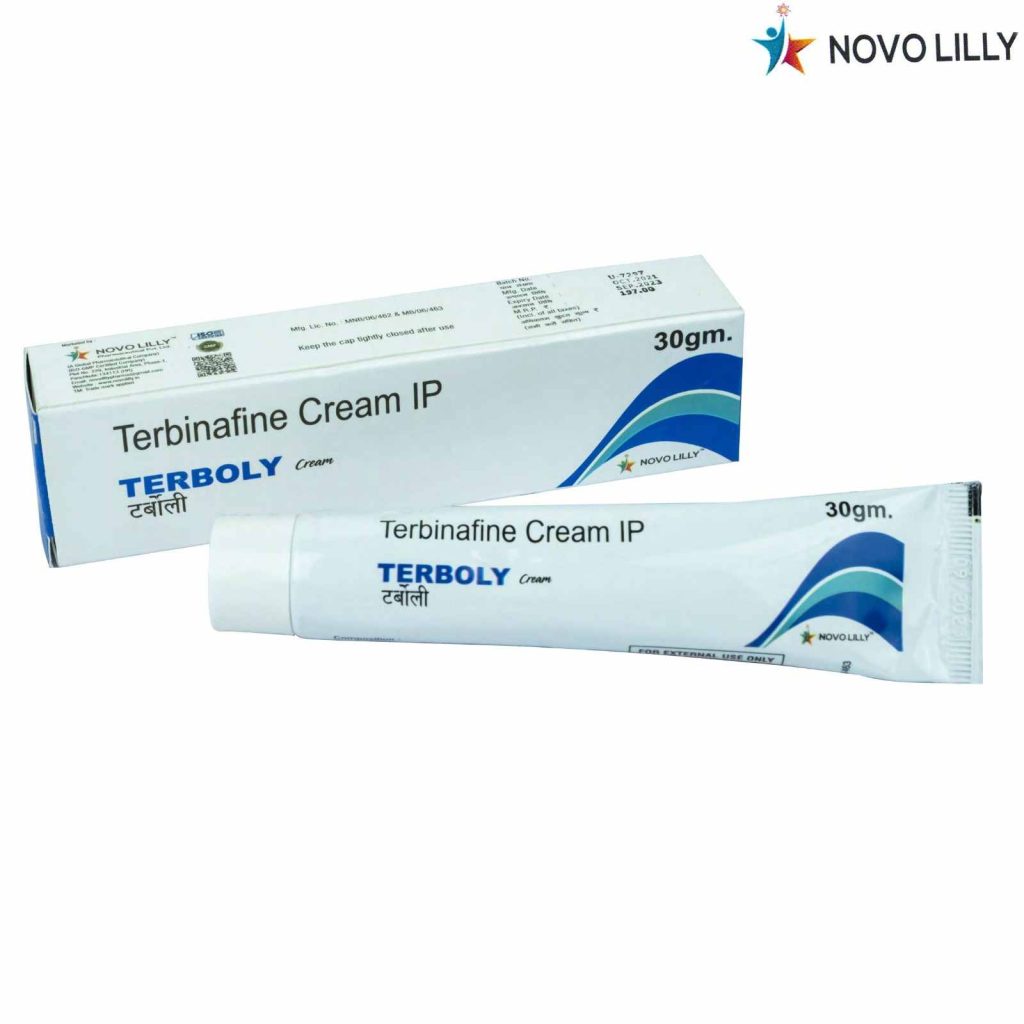
TERBINAFINE HYDROCHLORIDE 1%W/W + BENZYL ALCOHOL 1%W/W CREAM is a topical semisolid formulation containing terbinafine hydrochloride and benzyl alcohol at defined concentrations in a cream base. Developing a two-component topical cream requires careful consideration of active dispersion, vehicle compatibility, emulsion structure, viscosity, pH, homogeneity, and microbiological quality. The formulation must maintain a consistent distribution of both components throughout the cream without undesirable phase separation or changes in texture. For pharmaceutical manufacturers developing a diversified PCD Pharma Franchise portfolio, controlled semisolid processing and reproducible quality are essential.
The cream base forms the structural foundation of the finished product. Depending on the formulation design, it may contain aqueous and oil phases supported by suitable emulsifying agents, emollients, humectants, viscosity modifiers, preservatives, and other pharmaceutical excipients.
Terbinafine hydrochloride and benzyl alcohol have different physical characteristics, so their compatibility with the selected cream base needs to be assessed during formulation development. The active ingredient must be distributed uniformly, while benzyl alcohol needs to remain appropriately incorporated within the formulation without causing unwanted changes in the emulsion structure.
Compatibility studies can examine physical appearance, viscosity, pH, phase behaviour, and chemical stability. The selected excipient system should support a consistent semisolid structure during both manufacturing and storage.
Manufacturing of the cream may begin with separate preparation of the aqueous and oil phases. Each phase is processed according to the characteristics of its respective ingredients, with temperature and mixing conditions controlled throughout the preparation.
The phases are then combined under controlled agitation to create the desired emulsion structure. Homogenization can be used where required to reduce droplet-size variation and produce a smooth, uniform cream.
Terbinafine hydrochloride is incorporated according to its selected formulation pathway, which may involve controlled dispersion or dissolution depending on its behaviour within the vehicle. Benzyl alcohol is added at the designated stage of the manufacturing process to maintain its uniform distribution.
Parameters such as mixing speed, homogenization time, temperature, and addition sequence are established during formulation development and maintained during commercial-scale production.
The rheological behaviour of the cream influences its appearance, filling performance, spreadability characteristics, and storage stability. Viscosity must remain within a controlled range so that the finished product maintains a consistent semisolid structure.
During development, the formulation may be evaluated for viscosity at different shear conditions to understand its flow behaviour. Appearance, colour, odour, smoothness, and homogeneity are also assessed.
The cream should remain free from visible lumps, crystals, excessive air incorporation, and phase separation. Microscopic or other suitable evaluations may be performed where necessary to assess the distribution of the active component within the semisolid matrix.
pH is another important parameter, particularly when the formulation contains an aqueous phase. A suitable pH range can be established through compatibility and stability studies.
Quality control begins with testing terbinafine hydrochloride, benzyl alcohol, and all supporting excipients against approved raw-material specifications. Accurate dispensing is essential because both active components must be incorporated at their defined concentrations.
In-process controls may include bulk appearance, temperature, pH, viscosity, mixing conditions, and homogeneity. Finished-product testing can include identification, assay of the active component, viscosity, pH, microbial quality, appearance, and other applicable parameters.
For a water-containing cream, microbiological quality is particularly important. Manufacturing hygiene, controlled environmental conditions, suitable preservation where applicable, and microbiological testing work together to maintain the required quality of the finished product.
Representative sampling is also important because semisolid formulations must be adequately mixed before samples are taken for analytical evaluation.
Stability studies for TERBINAFINE HYDROCHLORIDE 1%W/W + BENZYL ALCOHOL 1%W/W CREAM can monitor changes in assay, pH, viscosity, colour, odour, appearance, phase separation, microbial quality, and other relevant attributes during storage.
Packaging compatibility should be evaluated because the cream may interact with the material of its final container. Aluminium tubes, laminate tubes, plastic tubes, or other suitable pharmaceutical containers may be considered according to the formulation requirements.
The selected packaging should protect the cream from contamination while maintaining the integrity of the semisolid matrix. Tube seal integrity, fill weight, product recovery, leakage resistance, and compatibility with the formulation can be evaluated during packaging development.
Light, temperature, and humidity conditions may also be incorporated into stability studies where relevant to the formulation.
The final packaging configuration should provide a suitable balance between product protection, dispensing convenience, and manufacturing consistency. Controlled filling ensures that each unit contains the intended quantity of cream, while proper sealing helps maintain product integrity during storage and transportation.
Batch coding, labeling, and packaging-line inspection further support traceability throughout the pharmaceutical supply chain.
For pharmaceutical businesses, TERBINAFINE HYDROCHLORIDE 1%W/W + BENZYL ALCOHOL 1%W/W CREAM can be included within a broader PCD Pharma Franchise portfolio when supported by appropriate regulatory requirements, quality specifications, and standardized manufacturing processes. Controlled emulsion preparation, consistent active distribution, reliable rheological properties, analytical testing, stability monitoring, and compatible packaging provide the technical foundation for reproducible topical product development.
Terbinafine HCl 1% + Benzyl Alcohol 1% Cream with formulation, cream manufacturing, quality control, stability and packaging details.