
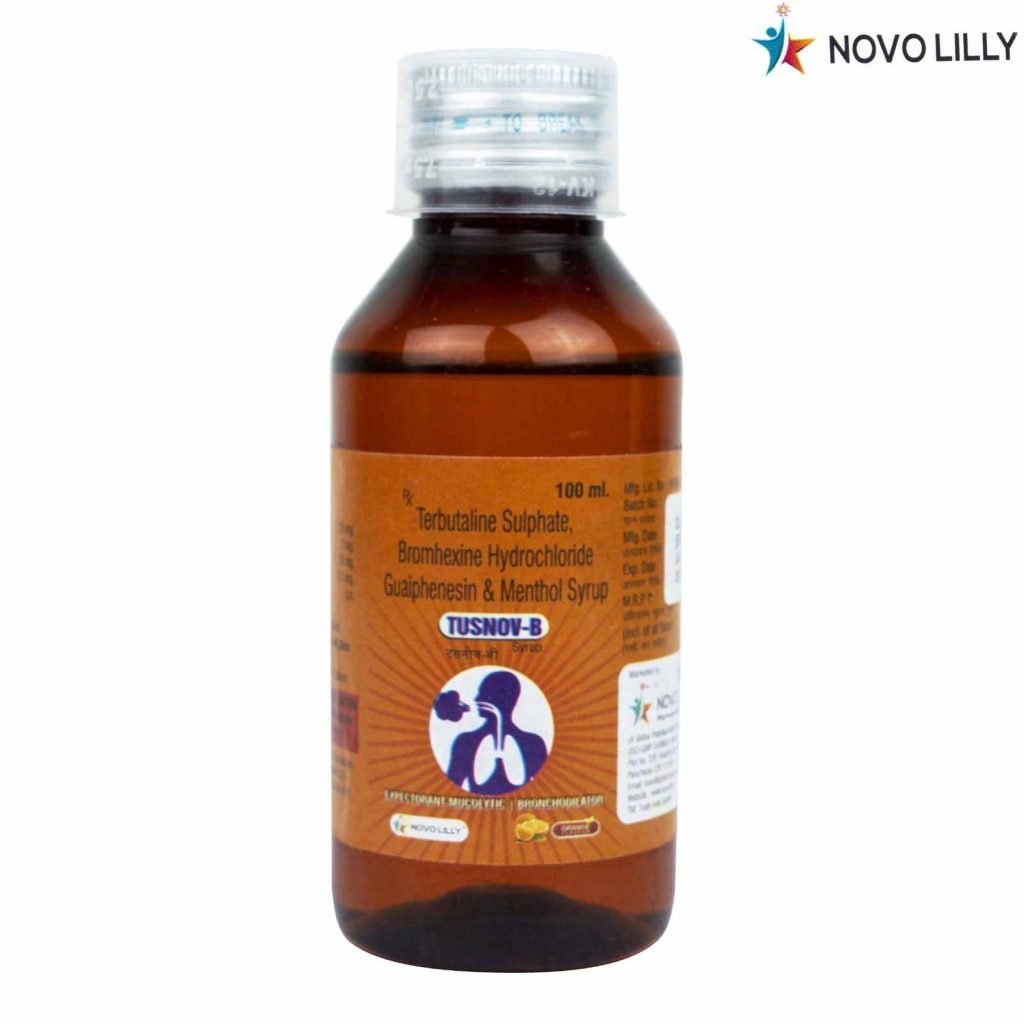
TERBUTALINE SULPHATE 1.25 MG + GUAIPHENESIN 50 MG + BROMHEXIN HCL 2 MG + MENTHOL 0.5 MG SYRUP Multi Ingredient Oral Syrup is a four ingredient formula consisting of different strength concentrations. When combining ingredients such as terbutaline sulphate, guaiphenesin, bromhexine hydrochloride and menthol into a single formulation the factors of different strength, solubility, sensory properties and handling characteristics that vary from one another will require formulation development and component incorporation into appropriate syrup bases, pH tuning, viscosity adjustment and assaying. For those pharmaceutical franchisees who have a Structured PCD Pharma Franchise portfolio, reproducibility of liquid processing and batch-to-batch consistency will be necessary.
The proportion of active ingredients in the formulation was also varied, with guaiphenesin at 50 mg and terbutaline sulphate, bromhexine hydrochloride and menthol incorporated at a much lesser level. These variations demand precise dispensing of raw-materials and the use of suitable blending methods to ensure similarity in the finished batch.
The liquid vehicle can comprise of purified water, sweetening agent, flavoring agent, viscosity agent, solubilizer, preservatives when required and other pharmaceutical excipients. The final system of excipients is recommended on the basis of the approved formulation and the required compatibilities.
At the development stage, the behavior of each single active is tested in the formulation you require for the vehicle. The indication of solubility, pH sensitivity, the particle profile where relevant and interactions with other ingredients in the formulation are taken into consideration.
The order of addition can also influence the quality of the resulting formulation: Various ingredients with different solubility characteristics may be split into separate solutions, which are individually prepared and added to the main vehicle.
Apart from the Menthol, which may be added from a suitable system of solubilization due to its physical properties, Terbutaline sulphate and other water soluble ingredients can be milled in accordance with their individual formulation and processing needs. Bromhexine hydrochloride and guaiphenesin are added under an emulsion or suspension.
Standard approach would be: prepare vehicle and soluble excipient phase, then carefully slowly add single actives. Rate of addition, temperature, mixing speed and processing time is determined during formulation development.
The finished bulk will be checked for homogeneity and physical appearance then moving to the filling process.
The more physical properties required for a syrup will be determined by its rheological properties. If viscosity is too high then filling has to be controlled accurately for dispensing it must be controlled so that during storage that it does not settle.
PH has gained significance as a development factor, as it can affect the chemical stability and solubility of active ingredients. An appropriate pH window is established based on Compatibility and Stability studies, it is not assumed while manufacturing.
Menthol is present in the formulation also to lend certain sensory characteristics. Flavoring and sweetening substances can be used in ways to impart a consistent overall taste and odor profile and yet be compatible with the active ingredients.
The syrup product should have an acceptable appearance and should not exhibit any inacceptable precipitation, crystallization or any other visible physical change during the approved shelf-life.
The first step in manufacturing is to identify, weigh, and verify all ingredients and excipients. Dispensing is especially critical because the four ingredients are not at the same strength.
In-process controls might involve bulk appearance, pH, viscosity, temperature, mixing conditions and homogeneity. These controls can be used to verify that the manufacturing process has not been exceed its operating range.
Testing of finished product may include identification and assay of terbutaline sulphate, guaiphenesin, bromhexine hydrochloride, and menthol, as well as pH, viscosity, microbial quality, fill volume, specific gravity if applicable, and other product-specific tests.
Analytical methods should be suitably selective in order to differentiate the multiple active ingredients in a liquid system. A sufficiently selective method and validated sample preparation steps can provide assurance when releasing batches.
The stability studies of TERBUTALINE SULPHATE 1.25 MG + GUAIPHENESIN 50 MG + BROMHEXIN HCL 2 MG + MENTHOL 0.5 MG SYRUP may be carried out to evaluate the alterations in assay, degradation products, pH, viscosity, color, odor, appearance, microbial quality, and other parameters.
The main package should be compatible with the syrup vehicle and able to protect the product during storage and transport. Pharmaceutical grade glass or plastic bottles can be tested on their stability performance.
The closure system is required to prevent leakage and external contamination, but at the same time provide product integrity. During the development stage of packaging, accuracy of fill-volume, performance of the cap, contact with the container, and product recovery can be measured.
Exposure to light and temperature may be incorporated into the stability protocols where applicable to the nature of the formulation.
TERBUTALINE SULPHATE 1.25 MG + GUAIPHENESIN 50 MG + BROMHEXIN HCL 2 MG + MENTHOL 0.5 MG SYRUP demands systematic regulations in the qualification of raw-materials, the production of liquid form, mixing of active ingredients, adjusting the viscosity, sensory development, quality control tests, stability testing and packing.
In addition, this multi-component syrup can be included in an extended portfolio of PCD Pharma Franchise for Phosphoric Acid if appropriate regulations, standardized manufacturing protocols, and necessary quality documents are in place. Complete documentation, suitable packaging, precise ingredient accuracy, dependable processing of liquids, and methods for analysis and stability studies can serve as the pillar of pharmaceutical syrup manufacturing.
Terbutaline + Guaiphenesin + Bromhexine + Menthol with formulation, manufacturing and quality details.