
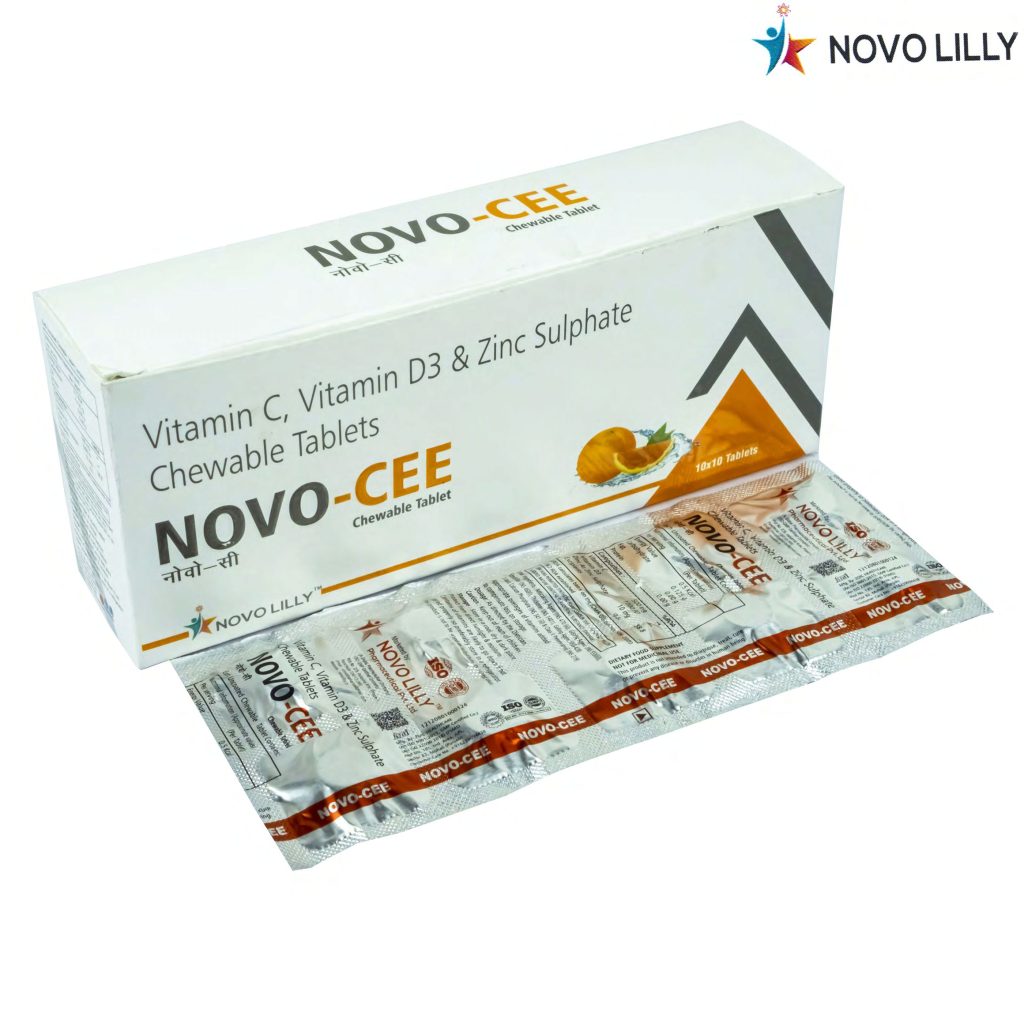
Vitamin C 500MG, Zinc 10MG, D3 Chewable Tablets comprise a nutritional solid dose formulation of Vitamin C, zinc and D3 in a chewable tablet format. Chewable tablets require specific chewable tablet development considerations due to their nature as a solid dose form and not being swallowed. Tastes (flavours and sweeteners), mouthfeel, tablet texture, friability and controlled disintegration all need to be carefully considered and designed for, as well as considering the formulation includes ingredients at different concentrations. For pharmaceutical companies expanding their nutritional product portfolio this formulation can be fitted into a well-organized range of D3 Pharma Franchise formulations.
Product is formulated with nutritional ingredients blended with an appropriate chewable base and excipients. During product development, powder flow, compression, chewability, palatability, hardness and stability are taken into account.
It provides a fortified dose of Vitamin C (500MG) and zinc (10MG) with Vitamin D3 as indicated. All ingredients are formulated into a chewable tablet system that delivers the right texture and mouthfeel.
Preparation, Calibration, and Inspection At the time of development, the physical properties of each ingredient (such as particle size distribution, bulk density, flowability, and sensitivity to moisture) are observed. The larger amount of Vitamin C listed results in the bulk powder nature of the final product, which is said ingredients like zinc and Vitamin D3 must be added in a controlled way in accordance to the specified quantities.
The blend of chewable excipients can include fillers and binder to be chewable, support the structure and mass of the tablet, (e.g., mouthfeel, mouth dissolvability, mouth go, flow) as well as flavoring and sweetening substances for the intended profile of the finished product.
Probing the interaction of the active ingredients with each of the excipients is part of the formulation development of each product. Raw materials are accurately weighed to the approved batch formula and identified and documented throughout the process.
Sensory Attributes Sensory attributes form an important element in chewable-tablet development. As a result of the acidity of Vitamin C, it may present a characteristic acidity, which has to be compensated for, using ingredients for taste-masking and/or sweetening.
The powder mixture should also remain in good distribution of the functional ingredients. Variations in particle size and density of Vitamin C, zinc compounds, Vitamin D3 and excipients can affect the mixing process.
A controlled sequence of additions can be used to allow lower inclusion components to be fed into the main formula matrix. Premixing or geometric dilution where possible can assist the distribution of micronutrient ingredients.
Samples of blends can be obtained from various points and subsequently tested by a analysis, suitable analytical method. The aim is to ensure that the value components have been evenly distributed before compression.
The compression stage must be finely controlled since chewable tablets are required to achieve a certain balance between good mechanical strength and chewability. Being too hard will affect the mouthfeel of the finished product and too weak can lead to excessive breakage during handling.
The compression force, machine speed, tooling and powder-feed parameters are all optimized during formulation development. The shape and size of tablets are determined in relation to the intended presentation of the product and total formulation weight.
In-process assessment may be the weight, thickness, hardness, friability, visual appearance and physical integrity of the tablets. Particular focus may be placed on surface glossiness, rim quality and uniformity between each tablet.
The formulation could also be tested as a compression before and after compression for sensory qualities. During development, attributes such as flavour, sweetness, texture and residual mouthfeel could be measured to determine the acceptable finished-product profile.
Quality Control Vitamin C, zinc and Vitamin D3 are tested in accordance with the product approved specification. The analytical procedures are chosen to allow for the confident identification and quantification of each individual nutrient component.
Finished-product testing can comprise assay, uniformity, average weight, variation in weight, friability, disintegration or other parameters relevant to a given formulation. The relatively low amount of Vitamin D3 used in a formulation may require appropriate analytical sensitivity to enable accurate measurement.
Sampling procedures will be established in order to achieve representative material from the manufacturing batch. The laboratory testing is supported by batch documentation to include raw-material testing, dispensing, blending, compression, and packaging.
The chewable form factor also makes physical and sensory consistency relevant quality attributes. Consistency in the size, texture and appearance of the tablet means a standardized presentation.
Stability assessment The stability of Vitamin C, zinc and Vitamin D3 in the chewable tablet matrix are taken into account. Various factors such as moisture, oxygen, temperature and light can have different effects on each individual element of the product and packaging plays a key role in the development of products.
Depending on the final formulation and stability specifications, approval may be required for appropriate blister packs, strips or other moisture-protective packaging types. Packaging needs to contribute to protect the texture of the tablet and to safeguard the nutritional constituents.
Assay, appearance, tablet quality characteristics including moisture content and other quality parameters can be checked at specific intervals. Seal integrity and material compatibility can also be studied.
Zinc 10MG D3 1000 IU Chewable Tablets PCD Pharma Franchise for health foods Nutritional Product Vitamin C 500MG Vitamin C is a compound used in various foods and beverages. For a pharma franchise based on food supplements an appropriate delivery of a chewable controlled dosage form, a constant sensory profile, micronutrient testing and packaging for protection will allow a product to be uniform and repeatable.
In general, the formulation development of this chewable product is a combination of nutrient-ingredient acceptance coupled with non-standard technology of a chewable tablet. Ingredient functionality, flavor & texture profile formulation, flow and uniformity, compression profile design, analytical verification, stability and pack engineering all work together to ensure reproducible manufacturing and finished-product quality.
Vitamin C 500mg, Zinc 10mg and D3 Chewable Tablets covering formulation, taste profile, manufacturing, quality testing, stability and PCD Pharma details.