
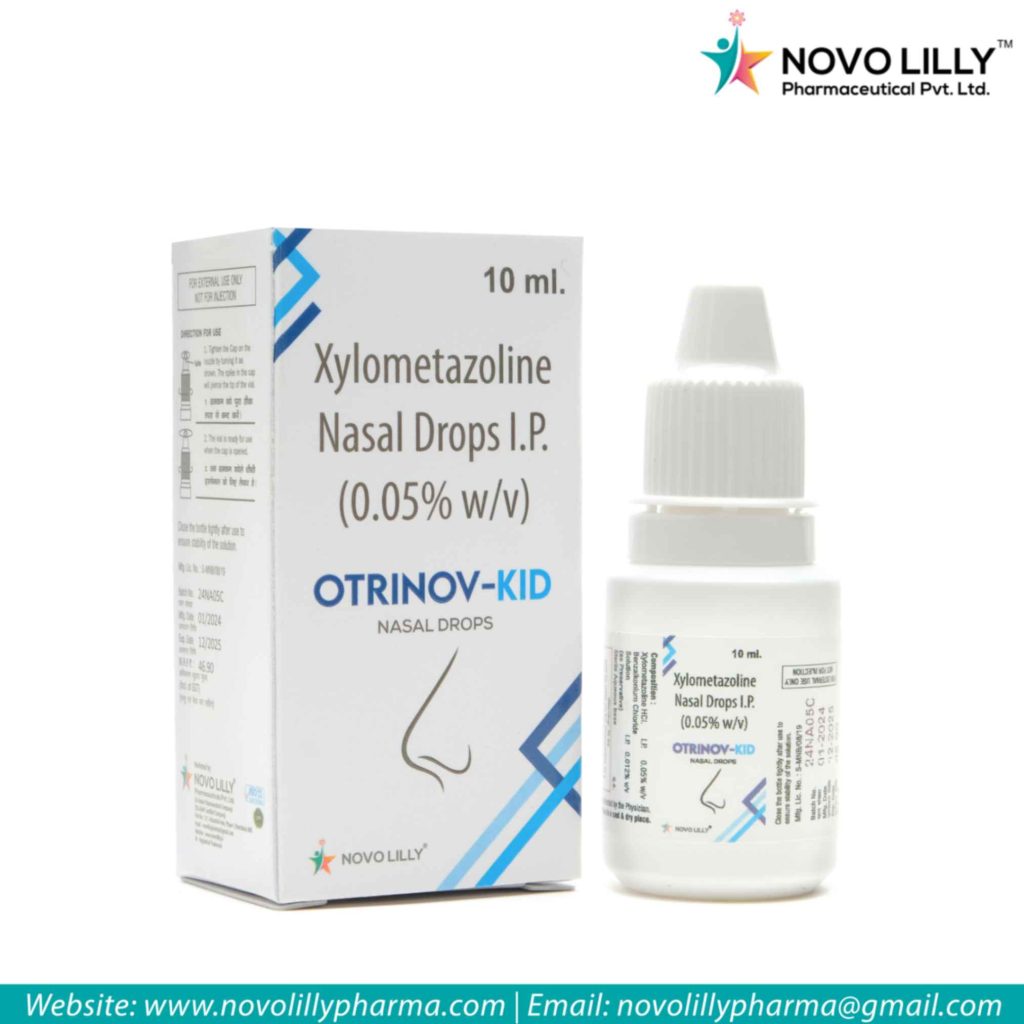
Consider a nasal drop formulated with such precision that every drop it is dispensed with, in end, becomes a resounding testimony of the precise science behind it. Xylometazoline Hydrochloride 0.05% W/V Nasal Drops is one such formulation that is low in concentration and relatively high in precision need, from ingredients to dispensed volume, for the pharmaceutical companies looking to venture into the area of nasal care.
Xylometazoline Hydrochloride 0.05% W/V Nasal Drops: How To Make Clarity at the Core To make the Xylometazoline Hydrochloride 0.05% W/V Nasal Drops, it all starts with preparation – getting the active to the right strength. Everything in the process has to be exact – weighing, diluting, filling.
The silent and liquid carrier is the medicine itself, formulated with pharmaceutical-grade materials following an approved formula. A recipe, derived from the one for the solution of injection, may comprise buffering agents, tonicity-adjusters, preservatives, and other excipients.
Consistency is King To ensure that the active and other ingredients are consistent in the solution, controlled mixing is used. The procedure describes all the steps: sequential addition, mixing time, temperature, and finally the volume, playing one piece of music, to ensure consistency.
What makes a nasal liquid? Balance of physical and chemical properties. What we include in the formulation must be acceptable for the nasal cavity. PH control Can influence everything from the stability of the active to the character of the solution.
If needed, a buffer system is then added to bring the pH into the proper range. The tonicity may be modified to suit the final formulation as well.
The end bulk doesn't just become a liquid, but a work of art tested for clarity, color, pH, viscosity, and specific gravity. This guarantees the consistency and accuracy when filling and dispensing every time!
The real challenge with nasal drops isn't the liquid, but how you get it out. Drop volume - the unsung hero of nasal delivery - is affected by much more than the nozzle's shape, including the bottle materials, viscosity, surface tension, and the way you hold the bottle.
During the development process the dropper is put through rigorous testing to determine if it will deliver a precise volume. The size of the container and size of the nozzle are also matched to the formulation to ensure there is not a high variation from drop to drop.
The filling equipment and processes are calibrated to produce a set fill volume. The control measures also include in-process checks of fill volume, bottle look, closure fit, leakage and drop delivery to prevent anything from getting through.
At only 0.05% concentration, the need for an analytical sensitivity is critical. It is necessary to accurately quantify the active ingredient without having the formulation matrix interfere.
Finished-product testing includes identification, assay, related substances, pH, clarity, microbial quality and fill volume. Every method used for testing has been validated or qualified and prepared for use.
Representative sampling is essential Results should be representative of a complete production batch. Quality assurance is supported by well-controlled sample preparation and stable reference standards.
Aqueous nasal products present unique microbiological quality concerns. Every step from pharmaceutical grade water, to equipment cleaning, to control of bulk holding time, to aseptic manufacture ensures quality.
Where a preservative system is employed, the incompatibility and efficacy should be ensured for the whole formulation. Finished-product microbial testing follows specification requirements.
Stability testing on the other hand examines the assay, related substances, pH, clarity, colour, microbial quality, handing of the product as it pertains to dispensing etc. it also looks at container integrity. Temperature and lights are looked at where applicable.
More than just a bottle Protect your product with quality packaging. Xylometazoline Hydrochloride 0.05% W/V Nasal Drops packaging ensures ease of delivery and protection of your pharmaceutical product. The quality of the bottle, dropper, cap and closure is validated in formulation and container-closure integrity studies.
Stability The type of bottle and dispense unit design is determined using stability data so that the product can endure during transport and storage without leakage or degradation.
When pharma companies are creating a deep PCD Pharma Franchise portfolio, this low-concentration nasal product becomes a certain part of a specially designed & dedicated range of Nasal drops. From its formulation to sensitive analysis & heavy microbial test to packaging, each stage of the manufacturing process is optimized for high-quality & consistency. Therefore, Xylometazoline Hydrochloride 0.05% W/V Nasal Drops always mark the integrity of their specified quality parameters during their shelf life.
Xylometazoline Hydrochloride 0.05% formulation, pH, dropper performance, quality control, stability and packaging details.